How to Pay for Lovable with Crypto When Your Card Gets Refused (2026)

Lovable does not accept cryptocurrency. There is no crypto checkout option for Pro, no stablecoin invoice for Business, and no on-chain payment path for Enterprise. Every subscription bills through Stripe, which lets Lovable take cards plus a broad set of wallets and local payment methods across more than 150 countries. Crypto is not one of them at any tier.
The workaround is a crypto-funded card. You load stablecoins onto a card, Lovable's Stripe checkout sees a standard Visa or Mastercard authorization, and the charge clears like any other card payment.
This guide covers the two methods that work in 2026, what each costs against real Lovable prices, and how to stop the declines that hit indie builders outside the US and EU hardest.
Lovable prices by credits, not by seats. One credit balance covers three things: build requests you send in the editor, Cloud hosting for the app you ship, and AI calls your deployed app makes. Pro and Business are single plans with a credit volume you pick from a credits-per-month dropdown, so what you pay tracks the credit tier rather than the headcount. Here is the structure as of July 2026, from Lovable's pricing page:
| Plan | Monthly | Annual (per month) | Credits included |
|---|---|---|---|
| Free | $0 | -- | 5/day, up to 30/mo, plus 20 Cloud credits |
| Pro (100 credits) | $25 | ~$21 ($250/yr) | 100/mo |
| Pro (200 credits) | $50 | ~$42 ($500/yr) | 200/mo |
| Pro (400 credits) | $100 | ~$83 ($1,000/yr) | 400/mo |
| Pro (800 credits) | $200 | ~$167 ($2,000/yr) | 800/mo |
| Business (100 credits) | from $50 | ~$42 ($500/yr) | 100/mo, unlimited members, plus workspace controls (per-member credit limits) |
| Enterprise | Custom | Custom | Custom |
Two things matter for payment planning. Credits roll over on paid plans, so most builders pick a tier and stay on it, which means you need a card that survives twelve consecutive renewals rather than one that clears once.
The second thing is more important, and most guides get it backwards: the recurring charge is exactly the plan price. Cloud and AI usage do not bill as an automatic overage. Usage past the small monthly Cloud and AI grants draws down the credit balance you already paid for, and when that balance hits zero, Lovable's documentation says building stops behind a blocking dialog until credits are available -- your published site keeps serving pages, but you cannot keep building. The only way a second charge reaches your card is a top-up you buy: a one-time purchase, or auto top-up, which is off until you switch it on.
Lovable itself is not hostile to international users. Stripe presents a wide range of wallets and local payment methods alongside cards, and it picks what to show based on where the buyer is. What it never shows is a crypto option, which means anyone holding funds on-chain ends up back at a card either way.
For a lot of builders, that card is the problem. Developers in Latin America, Southeast Asia, Nigeria, Turkey, and the Gulf routinely find local debit cards rejected on US-dollar SaaS charges, and the rejection usually comes from their own bank blocking international recurring merchants rather than from Lovable. The obvious workaround, a single-use virtual number or a gift-style prepaid card, tends to clear the first charge and then fail the second month. When a renewal fails, your credit grant stops and your projects drop back to free-tier limits.
Two smaller things trip people up. Stripe steps up authentication on some charges, and a card that cannot complete a 3D Secure challenge fails the payment even with funds sitting on it. And if you enable auto top-up, Lovable can charge the same card at unpredictable moments between renewals, whenever your credit balance crosses the threshold you set. A card funded to exactly the plan price clears the renewal on the first and then declines the top-up mid-build on the eleventh.
This is the method that works for essentially every Lovable plan, including annual billing and Business workspaces. A crypto debit card holds a fiat balance funded by your crypto deposit. When Lovable charges it, the transaction runs on ordinary Visa or Mastercard rails.
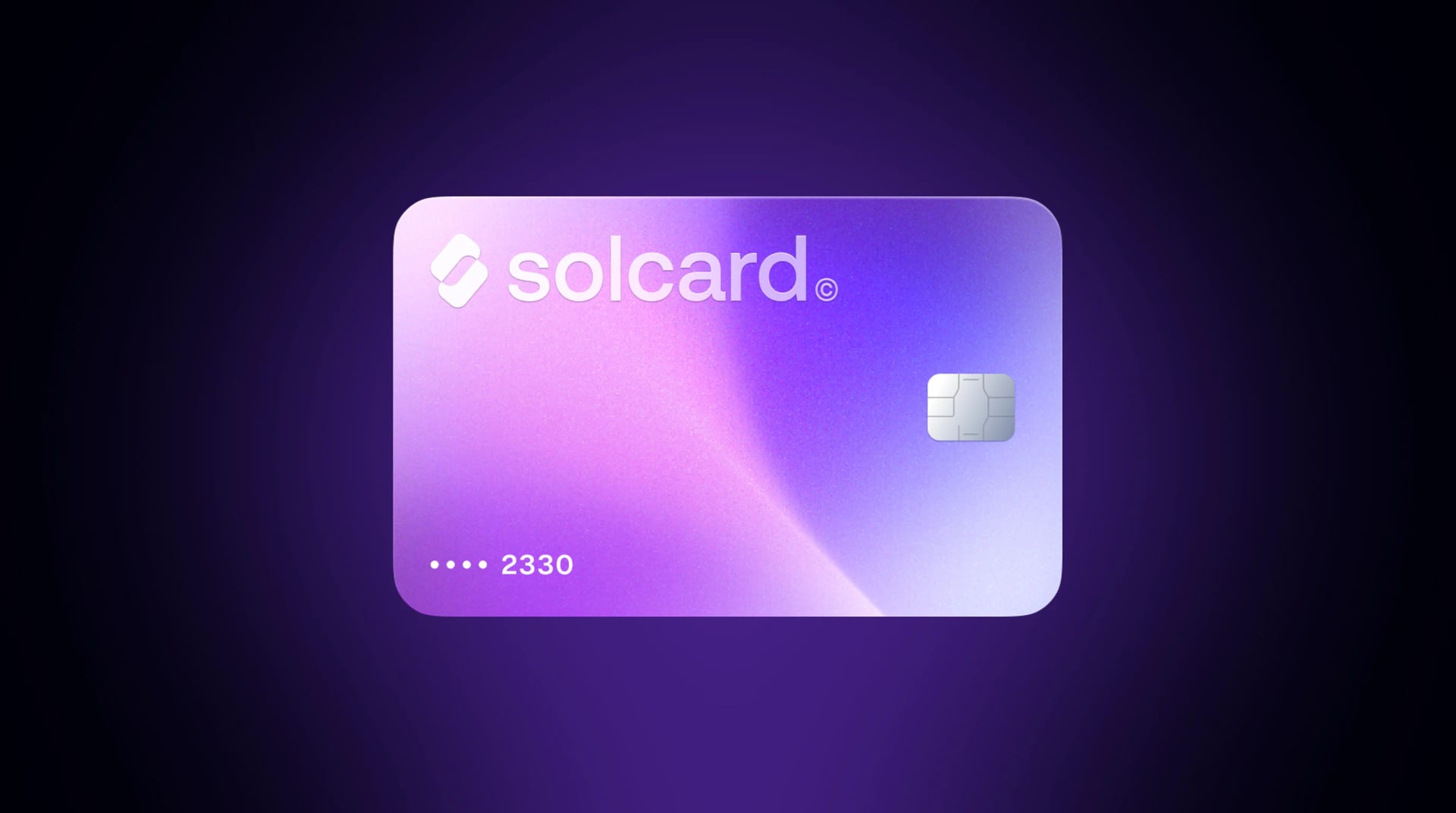
You fund a card balance with stablecoins, then enter that card at Lovable's Stripe checkout, and Stripe sees an ordinary Visa or Mastercard authorization against a funded account. SolCard accepts SOL, USDC, USDT, and SOLC across nine networks: Solana, Ethereum, Polygon, BSC, HyperEVM, Arbitrum, Optimism, Avalanche, and Base. Setup takes a few minutes if you already hold stablecoins; the full sequence, including how much to load so a renewal never fails, is in the step-by-step section below. For the general mechanics, see our guide on how to pay with crypto.
Lovable's checkout is a plain Stripe subscription. SolCard has recorded a 100% acceptance rate on Lovable: no Lovable charge has ever been declined for card-acceptance reasons.
That does not mean every charge succeeds. It means the failures we see are funding failures rather than acceptance failures: an underfunded balance, not the merchant refusing the card.
Pros:
- Supports recurring billing, so renewals happen untouched.
- Works for Pro, the higher Pro credit tiers, and Business workspaces.
- Handles mid-cycle credit top-ups as well as the renewal, as long as you keep headroom.
- Runs on Visa and Mastercard rails, usable in 200+ countries.
Cons:
- Top-up fees add a premium over the sticker price.
- You have to watch the balance; an empty card is a failed renewal.
- Not available in Hong Kong.
Fees vary more than the marketing pages suggest. Here is what a $25/month Lovable Pro plan actually costs across the main crypto card options:
| Card | Top-up / conversion fee | FX | Effective cost on $25/mo |
|---|---|---|---|
| SolCard Platinum | 0% | 0-1.5% | $25.00 (plus $10 one-time issuance) |
| SolCard Virtual | 5% | 1-2% | $26.25 (plus $10 one-time issuance) |
| Bybit Card | 0.9% crypto conversion | 0.5% | ~$25.23 |
| Cwallet Cozy Card | ~1.8% | varies | ~$25.45 |
| RedotPay | ~1% conversion | ~1.2% | ~$25.25 |
| Pay with Moon | 1%, $1.00 minimum | none | $26.00 |
Every figure in the last column is computed on the same basis: top-up or conversion fee only, with FX left out. FX is listed as its own column because it applies only when your card settles in a currency other than the one billed. Lovable bills in USD, so a USD-settled card sees no conversion spread on top of the top-up fee. If your card settles in another currency, add the FX column to the effective cost.
At $25/month the spread is small. It stops being small higher up. On Pro at the 400-credit tier ($100/month), a 0% top-up costs $100.00 flat while a 5% top-up costs $105.00, and across a year on Pro at the 800-credit tier ($200/month) that gap is $120.
Be plain about the trade-off between our own tiers. Both SolCard tiers carry the same one-time $10 issuance fee, so that part is a wash between them and it is not a reason to pick one over the other. What separates them is the running cost and the ceiling. The Virtual tier charges a 5% top-up fee and caps you at $5,000 per month, which is fine for a single Pro subscription and wrong for a studio on a Business workspace buying credit packs. Platinum removes the top-up fee and the monthly limit, lowers FX to 0-1.5%, and adds Apple Pay and Google Pay, but it is a physical card and requires identity verification.
If you would rather not add a card provider to the stack, you can sell crypto on an exchange, withdraw fiat to your bank, and pay Lovable with your existing bank card.
- Move crypto to an exchange that serves your country (Coinbase, Kraken, Binance, Bitstamp).
- Sell into your local currency or USD.
- Withdraw to your bank account. Expect one to five business days.
- Pay Lovable with the debit or credit card attached to that account.
Pros:
- Uses a bank-issued card, which is the strongest possible card profile at Stripe checkout.
- Native support for recurring billing and 3D Secure.
- No additional card provider in the chain.
Cons:
- Slow. A renewal that lands before your withdrawal settles still fails.
- Requires a bank account in a supported country, which is exactly the constraint many Lovable users are routing around.
- Selling crypto for fiat is a disposal in most tax jurisdictions.
- Not obviously cheaper once you count the exchange side plus the withdrawal.
Exchange fees and fiat withdrawal costs vary by venue and by rail, and none of the money is spendable until settlement clears. Add a currency conversion if your bank account is not in USD, and the cheaper-looking path often lands at or above a 0% top-up card with days of latency attached. See our guide on spending crypto without a bank account.
Open an account with a crypto card provider and issue a virtual card. Decide up front between a tier with a top-up fee and one with no top-up fee that requires identity verification. On SolCard that is Virtual versus Platinum.
Work to roughly a 30% buffer over the plan price. For Lovable Pro at $25/month, load at least $33; for Pro at the 400-credit tier ($100/month), load at least $130. The buffer is not for an overage, because Lovable does not bill one -- it covers the Stripe authorization, which is often presented slightly above the final charge, any FX spread if your card settles outside USD, and a credit top-up if you buy one mid-cycle. Top-ups run $15 per 50 credits on Pro and $30 per 50 credits on Business, so size the buffer to at least one top-up if you expect to need one. Stablecoins are the sane choice: USDC and USDT convert at a predictable rate, so what you deposit is close to what you can spend.
If you turn on auto top-up, budget for it deliberately. It fires on its own once your balance drops below the threshold you pick. Set the monthly spend limit Lovable offers, keep the card funded above it, or leave auto top-up off and buy credits by hand.
- Sign in at lovable.dev and open Settings.
- Go to Plans & credit usage.
- Choose your plan and credit tier, monthly or annual.
- Enter the card details in the Stripe checkout. To change the card later, use Manage on the plan card.
- Complete the 3D Secure challenge if prompted.
- Confirm the plan is active and your credit grant has landed.
Check the charge in your card provider's transaction history, then set a reminder a few days before the renewal date to top up. The most common failure mode on a crypto card is not a decline -- it is a card that quietly ran empty.
Check the balance first. On Lovable, funding is the overwhelmingly likely cause. Confirm the available balance exceeds the plan price plus a buffer.
Work out which charge failed. The renewal is always exactly the plan price. A charge that is not the plan price is a credit top-up, and if auto top-up is on it can hit the card on any day of the month. When an auto top-up is declined, Lovable emails workspace owners and admins and shows a banner in the dashboard and under Settings, then Plans & credit usage, with Retry charge and Update payment method options.
Confirm the card supports recurring charges. Single-use numbers clear the first charge and fail the renewal.
Complete the 3D Secure challenge. If a step-up appears and times out, the charge fails even with funds available. Keep your authentication device nearby for the first charge.
Do not retry with four different cards. Fix the funding, then retry once. Rapid-fire retries are how a solvable problem becomes a flagged account. While you are at it, match the billing address to the card's issuing country, because address-verification mismatches are a routine decline cause across Stripe merchants.
For a solo builder on Pro, a crypto card is the right answer and the fee difference between providers is a rounding error at $25/month. Optimize for renewals that never fail, not for the last twenty cents.
Further up the credit tiers, the top-up fee starts to matter. On Pro at the 800-credit tier ($200/month), 5% is $10 a month and $120 a year. Since the $10 issuance fee is identical on both SolCard tiers, the only thing you are trading is a verification step against that 5%, and at $200 a month the 5% costs you a full issuance fee every single month. A small studio on a Business workspace has the same arithmetic plus a ceiling to think about: you want no monthly cap and clean recurring behavior across repeat charges and credit top-ups, which points at Platinum rather than a virtual tier capped at $5,000 per month.
And if your bank is the thing blocking international SaaS charges, this is the core case. Your problem is not Lovable and not Stripe -- it is your issuer, and a card funded from stablecoins routes around it entirely.
If you pay for other AI tooling too, our roundup of the best AI subscriptions to pay with crypto and our guide to paying for Cursor with crypto cover the same mechanics.
In most jurisdictions, disposing of a digital asset is a taxable event, and spending crypto through a card counts as a disposal because the provider converts to fiat at the point of sale.
Generally taxable: selling crypto on an exchange before paying (Method 2), or funding a card with a volatile asset such as SOL, where the value at deposit differs from your cost basis.
Generally negligible: funding with USDC or USDT, where the asset holds a 1:1 peg and the realized gain is effectively zero.
For recurring software subscriptions, stablecoins are the cleanest option: predictable amounts, near-zero gain to report, a simple record of what you spent. Our guide on spending crypto without tax headaches goes deeper. None of this is tax advice. Rules vary by country, so confirm the treatment with a professional in your jurisdiction.
No. Lovable bills through Stripe, which offers cards alongside a broad set of wallets and local payment methods across more than 150 countries. None of those methods is crypto. There is no cryptocurrency checkout on the Free, Pro, Business, or Enterprise tiers and no published stablecoin invoicing path, so to pay with crypto you need a crypto-funded card in between.
Not by sending stablecoins to Lovable. You load USDC or USDT onto a crypto card and pay the Stripe charge with it. SolCard accepts SOL, USDC, USDT, and SOLC across nine networks including Solana, Base, Arbitrum, and Polygon. Stablecoins are the better choice because the funded amount does not move between deposit and charge.
Usual causes, in order: insufficient balance once you count the authorization buffer and any credit top-up you bought or auto-purchased; a single-use card number that cannot support recurring billing; an uncompleted 3D Secure challenge; or a billing address that does not match the card's issuing country. On crypto cards, funding is the dominant cause rather than merchant acceptance.
Yes, as long as the card number is persistent rather than single-use and the balance covers the charge. Stripe stores the card and re-charges it each cycle, and the renewal is exactly the plan price. Keep roughly a 30% buffer above it so the authorization, any FX spread, or a mid-cycle credit top-up does not break the renewal.
On Lovable Pro at $25/month, a 0% top-up card costs $25.00 and a 5% top-up card costs $26.25. At the 400-credit Pro tier ($100/month), that becomes $100.00 versus $105.00. Cards charging 0.9-2% conversion land in between. Both SolCard tiers add the same one-time $10 issuance fee at signup. FX may add 0-2% depending on the card and whether the charge settles in USD.
Yes. Business bills through the same Stripe checkout. Lovable does not charge per seat: workspaces support unlimited members and plans are priced by the credits they include, so the monthly charge scales with the credit tier you choose rather than with headcount. Pick the tier first, then check that your card has no monthly cap that charge would exceed. SolCard's Virtual tier caps at $5,000 per month; Platinum has no monthly limit.
For a renewal, the charge fails and Stripe retries it on a schedule. Your plan stays active during the retry window, then reverts to free-tier limits if the retries keep failing. For a credit top-up, the purchase simply does not go through: Lovable emails workspace owners and admins and shows a Retry charge banner. In both cases, fund the card, then retry once from Settings, then Plans & credit usage, in Lovable. For a wider comparison, see our best crypto debit cards roundup.
In most jurisdictions, yes, because spending crypto is a disposal. Funding with USDC or USDT makes the realized gain effectively zero because the peg holds, which is why stablecoins are simplest for recurring subscriptions. With SOL or another volatile asset, the gain or loss between cost basis and deposit value is reportable. Confirm the treatment in your own country.