Coinbase Card vs SolCard: Fees, Cashback & Availability (2026)
Coinbase Card vs SolCard compared in 2026: top-up and FX fees, conversion spreads, cashback, KYC tiers, and US vs global availability.

In this article
Choose Coinbase Card if you live in the US (outside Hawaii) and spend USDC from Coinbase for zero fees and rotating rewards; choose SolCard if you live outside the US, hold crypto in self-custody across multiple chains, or want a prepaid card without linking a bank or exchange account.
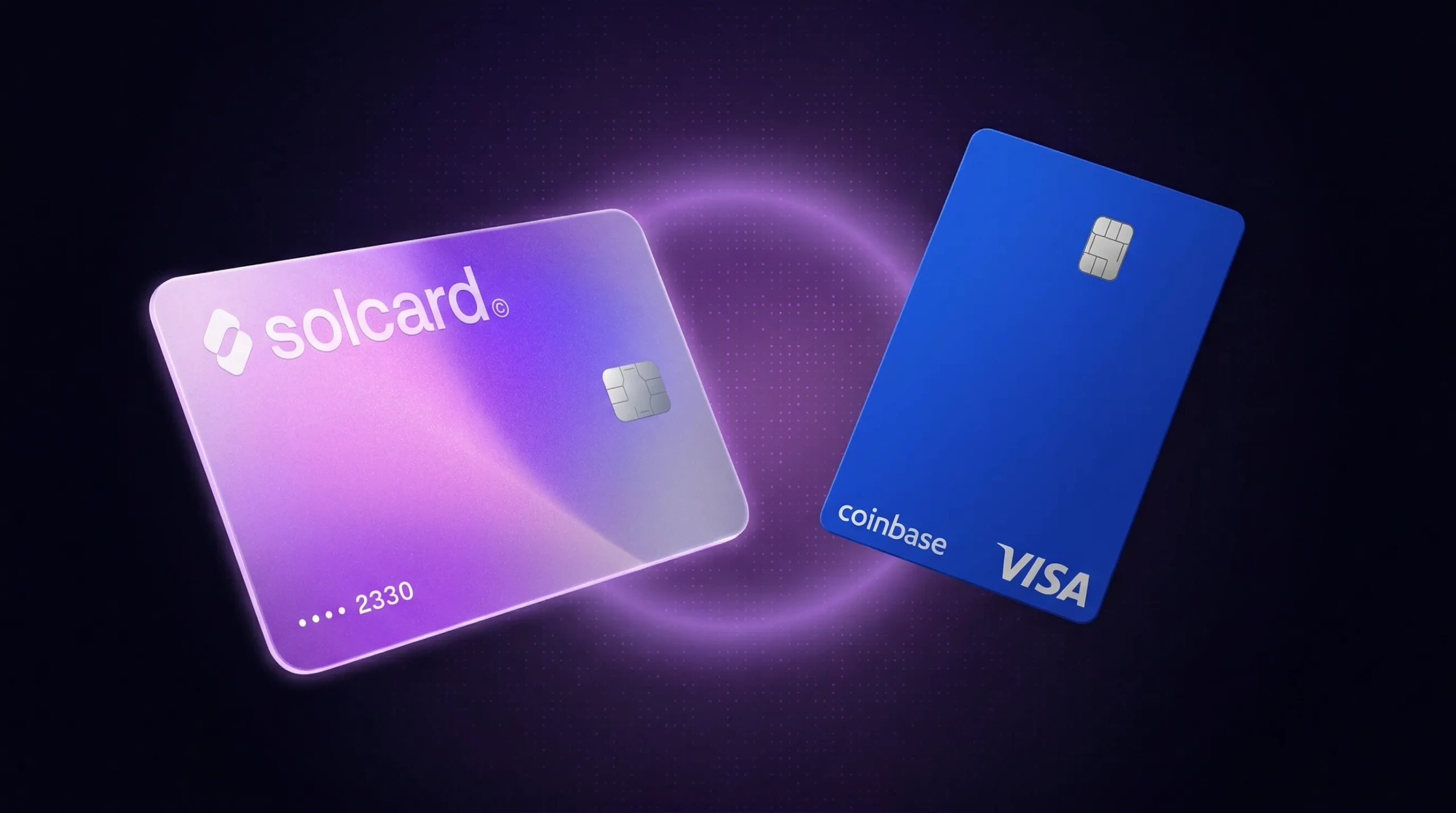
Both cards run on mainstream card rails, so merchants cannot tell you are paying with crypto. Beyond that, they are built for different people. Coinbase Card is a US-only Visa debit card wired into the Coinbase exchange. SolCard is a global prepaid Visa and Mastercard funded directly from any wallet across 9+ blockchains.
| Feature | SolCard | Coinbase Card |
|---|---|---|
| Network | Visa and Mastercard | Visa |
| Card format | Virtual (online) + Platinum (virtual, physical, Apple/Google Pay) | Virtual and physical debit |
| Identity verification | Not required for Virtual ($10k/mo cap); required for Platinum | Required for all users |
| Top-up / funding fee | 0% (Platinum) or 5% (Virtual) | 0% on USD/USDC; conversion spread on other crypto |
| FX fee | 0-1.5% (Platinum); 1-2% (Virtual) | 0% |
| Monthly fee | $0 | $0 |
| Card issuance | $10 per card | $0 |
| Per-transaction fee | $0.30 (per SolCard fee breakdown) | $0 |
| Supported crypto | SOL, USDC, USDT and other tokens across 9+ networks | 100+ tokens on Coinbase |
| Cashback | None | Variable rotating crypto rewards |
| Spend limits | $10,000/month (Virtual); no limit (Platinum) | Up to $5,000/day (tiered) |
| Availability | Most countries worldwide (US: Virtual only) | US only (excluding Hawaii) |
| Apple Pay / Google Pay | Yes (Platinum only) | Yes |
SolCard is a prepaid Visa and Mastercard funded directly from your crypto wallet, with no bank account and no credit check. You deposit SOL, USDC, USDT, or other supported tokens across 9+ networks including Solana, Ethereum, Base, and Polygon. The deposit converts to USD and loads onto your card for spending at 150M+ merchants in 200+ countries.
SolCard runs two tiers (see our full fees schedule):
- Virtual: no identity verification required, $10,000 monthly limit, 5% top-up fee, $10 one-time issuance fee per card, 1-2% FX spread, online payments only (no Apple Pay or Google Pay). Available in the US and most countries worldwide.
- Platinum: identity verification required, 0% top-up fee, 0-1.5% FX spread, no monthly limit, multiple virtual cards plus physical card access, and Apple Pay and Google Pay. Not available in the US.
SolCard does not offer cashback or a credit line. Its pitch is direct wallet-to-card funding, global access, and 0% top-ups on Platinum.
The Coinbase Card is a Visa debit card issued by Pathward, N.A. and tied straight to your Coinbase exchange account. You pick which asset in your Coinbase portfolio to spend, and Coinbase converts it to USD at the moment you tap or swipe.
There is no separate top-up step because your Coinbase balance is your card balance. You get Apple Pay, Google Pay, a physical card with ATM access, 0% foreign transaction fees, and variable crypto rewards shown inside the app. Coinbase also offers a separate Coinbase One Card (American Express) with 2% to 4% back in Bitcoin for paid Coinbase One members ($49.99+/year, top tiers capped at $10,000/month).
The catch is geography and spreads: Coinbase Card is strictly US-only (excluding Hawaii), requires full Level 2 KYC (ID, selfie, SSN), and charges a conversion spread whenever you spend anything other than USD or USDC.
The fee structures look completely different once you run actual numbers.
On $100 of USD spending funded with USDC:
- SolCard Platinum costs $0.00.
- Coinbase Card costs $0.00.
- SolCard Virtual costs $5.00 (5% top-up fee).
On $100 of USD spending funded with non-stablecoin crypto (such as SOL or BTC):
- SolCard Platinum costs $0.00 in top-up fees.
- Coinbase Card charges a conversion spread listed on Coinbase's fee page, which reduces or wipes out the rotating reward.
- SolCard Virtual costs $5.00.
On 30 monthly purchases of $20 ($600 total) in a foreign currency:
- Coinbase Card charges $0.00 in FX fees (if funded with USD or USDC).
- SolCard Platinum charges $0 to $9.00 (0-1.5% FX spread, 0% top-up).
- SolCard Virtual charges $30.00 in top-up fees plus $6 to $12 in FX spread.
Spend USDC on Coinbase Card to avoid the spread
If you use Coinbase Card, convert to USDC on Coinbase Advanced first or hold USDC directly. Paying directly from BTC or ETH triggers Coinbase's retail conversion spread on every coffee and grocery run, plus creates a taxable disposal with the IRS.
Coinbase Card requires full US identity verification (government ID, selfie, Social Security number, and proof of address) with no reduced-verification option.
SolCard splits verification by tier. The Platinum tier requires standard KYC and liveness checks in exchange for 0% top-ups, unlimited monthly spend, and mobile wallets. The Virtual tier needs no ID up to $10,000/month, which is useful if you want a quick prepaid card for online subscriptions without uploading documents, though you pay a 5% top-up fee for that convenience.
Neither card is anonymous or untraceable: card transactions run on Visa and Mastercard rails, and SolCard enforces country restrictions and compliance screening.
For most readers, geography settles the comparison immediately.
- Outside the United States: Coinbase Card is unavailable. SolCard works across Europe, Asia, Latin America, Oceania, and parts of Africa (excluding restricted jurisdictions such as Cuba, North Korea, Egypt, Iran, Myanmar, Nigeria, Russia, South Africa, Syria, Ukraine, Venezuela, Belarus, and Hong Kong).
- Inside the United States: Coinbase Card is available in 49 states (not Hawaii) with full features, physical card, and Apple Pay. SolCard offers its Virtual tier only in the US (online spending, 5% top-up, $10,000/month limit); Platinum is not available to US residents.
US residents cannot get SolCard Platinum
If you live in the US and want Apple Pay, a physical card, or 0% top-up fees, SolCard Platinum is not available in your region. For everyday US spending with USDC, Coinbase Card is the cheaper option.
Pick SolCard if you live outside the US and want 0% top-ups on Platinum with Apple Pay and Google Pay, if you keep your funds in self-custody wallets across Solana, Ethereum, Base, or Polygon rather than on an exchange, or if you want a Virtual card for online spending without a bank account or credit check.
Pick Coinbase Card if you live in the US (excluding Hawaii), already hold USD or USDC on Coinbase, want 0% foreign transaction fees and a physical card for ATMs, and do not mind full exchange KYC.
For more head-to-head matchups, read our best crypto debit cards roundup, SolCard vs Gemini Card, and SolCard vs RedotPay.
Coinbase Card charges no annual fee, no monthly fee, no foreign transaction fee, and $0 on USD or USDC purchases. Spending any other cryptocurrency triggers a conversion spread published on Coinbase's fee page.
Yes. Coinbase Card pays variable rotating crypto rewards on every purchase (and the separate Coinbase One Amex pays up to 4% in Bitcoin with a paid membership). SolCard does not offer cashback, competing instead on 0% Platinum top-ups and global multi-chain access.
No. Coinbase Card is restricted to US residents (excluding Hawaii). Outside the US, SolCard serves most countries with both Virtual and Platinum tiers.
Physical card access, multiple virtual cards, and Apple Pay / Google Pay are part of SolCard's Platinum tier (available outside the US with identity verification). The Virtual tier is online-only.
For US residents traveling abroad, Coinbase Card wins because it charges 0% FX fees and $0 on USDC spend. For non-US residents, Coinbase Card is unavailable, making SolCard Platinum (0% top-up, 0-1.5% FX) the practical option.
Coinbase Card requires full KYC for everyone. SolCard's Virtual tier requires no ID up to $10,000/month, but carries a 5% top-up fee and works online only.
These two cards barely overlap. If you are in the United States and spend USDC, Coinbase Card is free to use, supports Apple Pay and ATMs, and pays rotating rewards. If you live outside the US or prefer funding a prepaid card straight from your own wallet across 9+ chains without tying your spending to a single exchange, SolCard is built for that workflow.