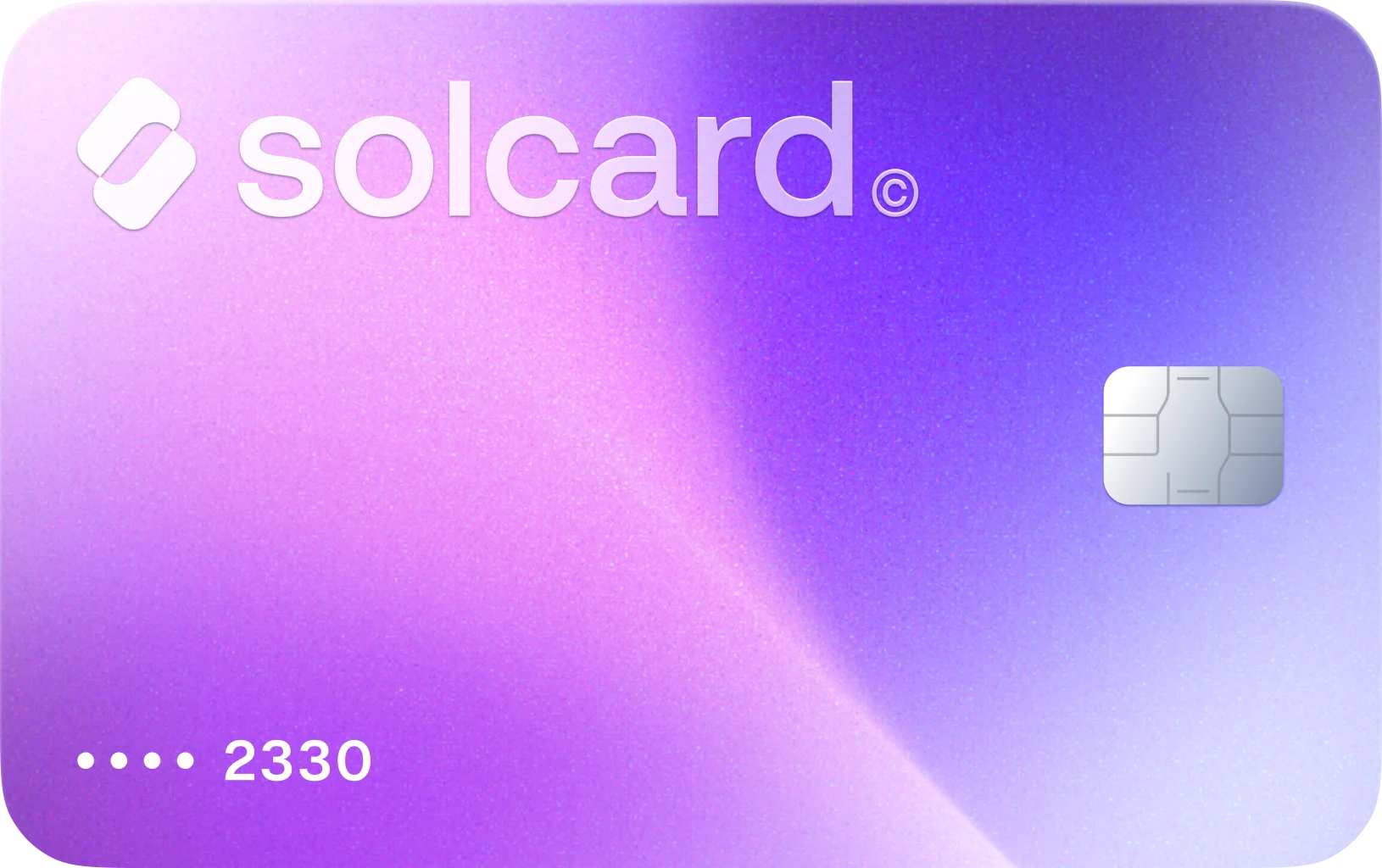
Pay Upstash with Crypto
Use SolCard for Upstash's direct card billing when you upgrade Redis, Vector, QStash, Workflow, or Search from free to paid.
48% of buyers purchase again at Upstash · Based on real card transactions
How to use crypto for Upstash billing
Get Your SolCard
Sign up for SolCard in minutes. Get your virtual card instantly or order a physical card delivered to your door.
Load Your Crypto
Deposit SOL, USDC, USDT, or SOLC directly from your crypto wallet across 9 supported blockchain networks.
Add SolCard in Upstash Billing and upgrade
Open the Upstash console, go to `Account` > `Billing`, add your SolCard, then use it for eligible Redis, Vector, QStash, Workflow, Search, or Prod Pack charges billed directly by Upstash.
Why SolCard fits Upstash's billing model
Upstash is not a one-plan SaaS. The same account can spend on Redis databases, Vector indexes, QStash message delivery, Workflow runs, and Search, so SolCard is useful when your crypto-funded spend is split across several Upstash services.
For direct self-serve billing, Upstash tells customers to add a card in `Account` > `Billing`, and its billing docs say Stripe handles the payment processing. SolCard works with that existing card path instead of relying on a native crypto checkout that Upstash does not document.
On Redis pay-as-you-go, Upstash lets you set a monthly budget, sends email alerts at 70% and 90% of the cap, and throttles the instance rather than charging past the limit. That gives you a concrete number to keep ready on SolCard when command, storage, or bandwidth costs might jump.
Upstash bills each product differently: Redis by requests, storage, and bandwidth; Vector by query and update requests; QStash by messages; Workflow by steps built on QStash messages; and Search by requests, stored documents, and reranking. SolCard is easier to manage when one monthly bill mixes several of those meters.
When traffic stabilizes, Upstash also offers flat recurring plans such as Redis fixed tiers from $10 per month, Vector Fixed at $60 per month, and QStash or Workflow fixed tiers from $180 per month, plus Prod Pack at $200 per month where offered. SolCard works well when you want those recurring charges on a dedicated crypto-funded card.
Upstash documents that failed payments can suspend account resources, and upgrading a free Redis database after adding a payment method restarts the database with about 1 to 2 seconds of downtime. Keeping SolCard funded and added in advance helps you handle upgrades and renewals without last-minute payment friction.
Pay Upstash with 4 supported tokens across 9 blockchain networks
About Upstash
Upstash sells serverless data infrastructure for developers, including Redis databases, Vector indexes, QStash message delivery, Workflow runs, and Search databases. Customers often start on a free tier and then move to pay-as-you-go or fixed monthly plans inside the Upstash console, with optional production add-ons such as Prod Pack where available. Upstash documents card billing through its Billing page and Stripe rather than native crypto checkout, so SolCard is a practical way to cover Upstash's direct card charges with crypto.
Upstash billing FAQ
Upstash's self-serve billing docs tell users to add a credit card in `Account` > `Billing`, and the company says Stripe handles those payments. Upstash also offers AWS Marketplace billing, but it does not currently document a native crypto checkout. SolCard is therefore most relevant for Upstash's direct card-billing path.
What users say about paying Upstash with SolCard
No reviews yet. Be the first to try SolCard at Upstash.
Supporting guides related to Upstash
Use these guides to branch from Upstash into adjacent merchant workflows, category-level comparisons, and broader SolCard payment explainers.
How to Pay for Hostinger Web Hosting with Crypto: A Complete Guide for 2026
Pay for Hostinger hosting with crypto using CoinGate or a crypto-funded virtual card. Step-by-step guide with real costs, plan breakdowns, and tips.
Read guideBest Crypto Payment Gateways for Businesses in 2026
Compare the best crypto payment gateways for businesses in 2026 -- features, fees, supported coins, and integration options for accepting crypto.
Read guideStripe Crypto Payments: A Complete Guide to Web3 Integration
Stripe crypto payments explained -- from stablecoin checkout and fiat-to-crypto onramps to USDC payouts and web3 integration for businesses.
Read guideWeb3 Payments Explained: The Future of Spending Crypto
A comprehensive guide to web3 payments — how decentralized payment infrastructure works, key platforms, and why web3 is reshaping how we spend crypto in 2026.
Read guideUsers who shop at Upstash also shop at

Buy on MongoDB with Crypto
Use SolCard to pay MongoDB with SOL, USDC, USDT, and SOLC across 9 blockchain networks. Cover MongoDB Atlas self-serve billing for Flex clusters, dedicated deployments, backups, and other Atlas usage through MongoDB's regular card flow.
Learn more
Buy on Render with Crypto
Use SolCard to pay for Render hosting, managed databases, preview environments, and usage-based charges with SOL, USDC, USDT, and SOLC across 9 blockchain networks.
Learn more
Buy on Vercel with Crypto
Use SolCard to pay Vercel Pro fees, extra seats, usage overages, add-ons, and domain renewals with SOL, USDC, USDT, and SOLC across 9 blockchain networks.
Learn more
Buy on X with Crypto
Use SolCard to pay for X Premium, creator subscriptions, gifts, and X Ads with SOL, USDC, USDT, and SOLC across 9 blockchain networks.
Learn more
Buy on Google Services with Crypto
Use SolCard to pay for Google One, YouTube Premium, Google Workspace, and eligible Google Cloud charges with SOL, USDC, USDT, and SOLC across 9 blockchain networks.
Learn more