SolCard vs MetaMask Card: Spending Crypto in 2026
SolCard vs MetaMask Card compared for 2026: prepaid vs self-custodial models, fees, supported networks, KYC rules, cashback, and regional availability.

In this article
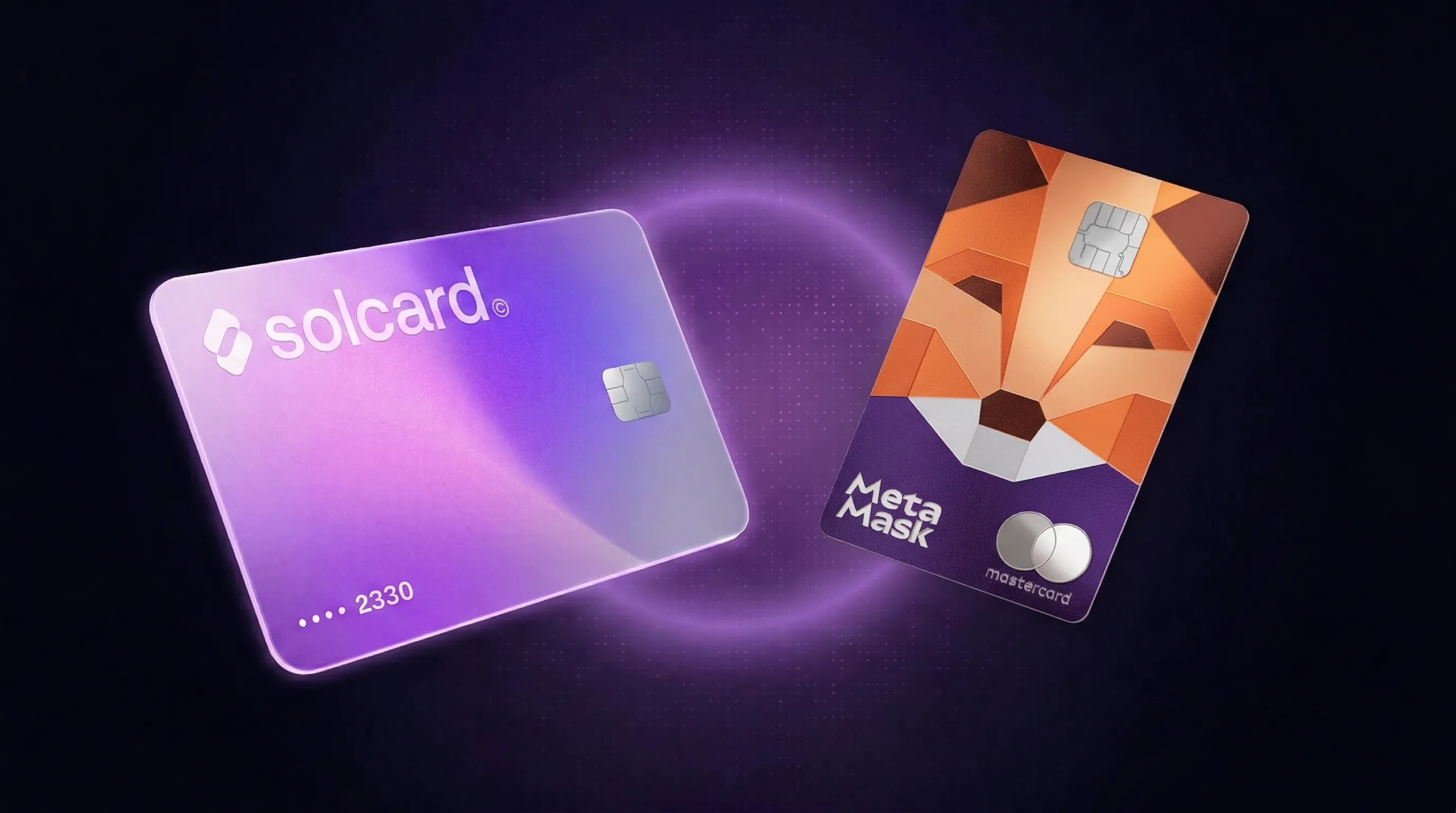
SolCard is a multi-chain prepaid card with an optional no-verification Virtual tier and wide global coverage, while MetaMask Card is a self-custodial Mastercard that keeps tokens in your wallet until checkout and pays 1-3% cashback in mUSD. Both let you spend crypto at everyday merchants without routing through a centralized exchange, though they make opposite trade-offs on custody, fees, identity verification, and rewards.
This comparison breaks down how each crypto debit card works in 2026 so you can pick the one that fits how you hold and spend crypto.
| Feature | SolCard | MetaMask Card |
|---|---|---|
| Custody model | Custodial (prepaid) | Self-custodial |
| Supported networks | 9+ networks (Solana, Ethereum, Base, Polygon, and more) | Linea, Base, Monad, Solana |
| Card network | Visa and Mastercard | Mastercard |
| Card tiers | Virtual ($10 issuance) or Platinum ($10 issuance, physical + virtual) | Virtual (free) or Metal ($199/yr) |
| Identity verification | Optional (Virtual: none; Platinum: required, not US) | Required for all tiers |
| Supported tokens | SOL, USDC, USDT, BTC, ETH, and more | USDC, USDT, mUSD, wETH, aUSDC, EURe, GBPe (varies by region) |
| Top-up fee | 5% (Virtual) / 0% (Platinum) | None (network gas applies) |
| Per-transaction fee | $0.30 | Network gas (~$0.01 on Linea) |
| Foreign transaction fee | 1-2% (Virtual) / 0-1.5% (Platinum) | 1% (Virtual) / 0% (Metal) |
| Rewards | No cashback program | 1% mUSD (Virtual) / 3% on first $10k/yr (Metal) |
| Mobile wallets | Apple Pay, Google Pay (Platinum) | Apple Pay, Google Pay |
| Availability | 200+ countries (short restricted list) | EU/EEA, UK, Brazil, Canada, Mexico, Argentina, Colombia, Switzerland (US signups temporarily paused) |
The biggest architectural split between these two cards is when your crypto converts to fiat.
SolCard is a prepaid card. You deposit SOL, USDC, USDT, BTC, ETH, or other supported tokens across 9+ networks, your deposit converts into a USD card balance, and you spend from that balance like any debit card. Once loaded, your purchasing power does not fluctuate with token prices, and checkout needs no on-chain approval.
MetaMask Card is self-custodial. Your tokens stay in your MetaMask wallet until you tap, swipe, or check out online. At the point of sale, the card converts the exact spend amount from your wallet to fiat over Mastercard rails. That lets you keep custody of your assets and even hold yield-bearing tokens like aUSDC right up until you spend them.
If you want strict self-custody and yield until checkout, MetaMask Card's architecture is the clear standout. If you prefer loading a fixed USD spending budget from any wallet across Solana, Ethereum, Bitcoin, or EVM chains, SolCard's prepaid model is simpler.
Neither SolCard tier charges a monthly or annual fee, and both carry a $10 one-time card issuance fee and a $0.30 per-transaction fee per SolCard's fee schedule:
- Virtual: 5% top-up fee, 1-2% FX spread on non-USD purchases, $10,000 monthly limit, online-only (no Apple Pay or Google Pay).
- Platinum: 0% top-up fee, 0-1.5% FX spread, no monthly limit, physical and virtual cards, Apple Pay and Google Pay enabled.
Per MetaMask Card's FAQ, there is no top-up fee because funds stay in your wallet. You pay network gas at checkout (typically around $0.01 on Linea). Spending local-currency stablecoins incurs no conversion fee, while spending non-stablecoins like wETH adds a 0.875% swap fee. Cross-border purchases carry a 1% FX fee on the free Virtual tier and 0% on the $199/year Metal tier.
For frequent small purchases in a supported region, MetaMask Card Virtual wins on cost: $0 issuance, ~$0.01 gas per transaction, and 1% cashback in mUSD. For heavy travelers spending $10,000+ abroad each year, MetaMask Metal's 3% cashback (up to $300 on the first $10,000) and 0% FX easily offset its $199 annual fee.
SolCard Platinum is competitive on large domestic USD purchases (0% top-up, $0.30 flat per transaction, $0 annual fee), while SolCard Virtual costs more per dollar loaded (5% top-up) because you are paying for no-verification onboarding and US availability.
MetaMask Card requires KYC for every user through regulated issuing partners (Cross River Bank in the US and Monavate in Europe). It is available across the EU/EEA, UK, Brazil, Canada, Mexico, Argentina, Colombia, and Switzerland. While MetaMask announced its US rollout in February 2026, new US signups are temporarily paused.
SolCard covers 200+ countries outside a short restricted list (including Cuba, North Korea, Iran, Russia, and Hong Kong). Its Virtual tier requires no identity verification and works in the US and most other countries. Platinum requires identity verification and is not available in the US.
Check regional availability before picking
If you live in the US while MetaMask Card signups are paused, SolCard Virtual is immediately usable for online spending, though it lacks Apple Pay and carries a 5% top-up fee. If you live in the EU, UK, Canada, or Latin America and are happy to complete KYC, both MetaMask Card and SolCard Platinum are open to you.
SolCard accepts deposits across 9+ networks, including Solana, Ethereum, Base, Polygon, Arbitrum, Optimism, Avalanche, BNB Smart Chain, and more, covering SOL, USDC, USDT, BTC, ETH, and additional tokens. SolCard does not offer a cashback program.
MetaMask Card spends directly from four networks: Linea, Base, Monad, and Solana. Depending on region, supported tokens include USDC, USDT, mUSD (a dollar-pegged stablecoin issued by Stripe-owned Bridge), wETH, aUSDC, EURe, and GBPe. Cardholders earn 1% back in mUSD on Virtual, or 3% on the first $10,000 spent annually (1% thereafter) plus travel perks on Metal.
Choose SolCard if you:
- Live outside MetaMask Card's active signup regions (including the US while MetaMask US signups remain paused).
- Want to spend from Bitcoin, Ethereum mainnet, Polygon, or other chains beyond MetaMask Card's four spending networks.
- Prefer a prepaid USD balance with no annual fee and an optional no-verification Virtual tier.
Choose MetaMask Card if you:
- Live in an active region (EU/EEA, UK, Canada, Brazil, Mexico, Argentina, Colombia, or Switzerland) and are comfortable with KYC.
- Want self-custody so funds stay in your wallet (or earn yield in aUSDC) until the moment of purchase.
- Want 1% to 3% cashback in mUSD and mobile wallet tap-to-pay without a top-up fee.
Yes. Neither provider restricts you from holding another crypto card. Many users keep a self-custodial card for everyday tap-to-pay rewards and a multi-chain prepaid card as a backup or for online subscriptions.
MetaMask Card Virtual is cheaper for frequent small purchases because it has no top-up fee, ~$0.01 Linea gas, and 1% cashback. SolCard Platinum has 0% top-up and $0 annual fee, charging a flat $0.30 per transaction. SolCard Virtual carries a 5% top-up fee in exchange for skipping identity verification.
SolCard accepts BTC deposits alongside SOL, USDC, USDT, ETH, and other tokens across 9+ networks. MetaMask Card spends from Linea, Base, Monad, and Solana, so native Bitcoin must be swapped or bridged to a supported token first.
Not for the Virtual tier, which supports online spending up to $10,000/month. Upgrading to Platinum for 0% top-ups, no monthly limit, physical cards, and Apple Pay / Google Pay requires identity verification (not available in the US).
mUSD is a dollar-pegged stablecoin issued by Bridge (a Stripe company). MetaMask Card pays cashback in mUSD and lets you spend it directly from your wallet.
MetaMask Card Metal waives foreign transaction fees completely for $199/year and includes 3% cashback on the first $10,000 spent annually. If you do not want an annual fee, MetaMask Virtual charges 1% FX and SolCard Platinum charges 0-1.5% FX.
MetaMask Card is the stronger everyday card if you live in a supported region, want self-custody, and value 1-3% cashback with $0 top-up fees. SolCard wins on geographic reach, broader deposit networks (including BTC and Ethereum mainnet), and an optional no-verification Virtual tier. For a wider look at your options, see our best crypto debit cards guide or compare SolCard with the Gemini card and the Nexo card.