How to Spend Crypto Without a Bank Account (2026 Guide)
Five real ways to spend crypto without a bank account in 2026: crypto debit cards, gift cards, P2P, Bitcoin ATMs, and e-wallets, with honest fees and limits.

In this article
Yes, you can spend crypto without a bank account or credit check using five working routes: a crypto debit card for everyday spending at 150M+ merchants, gift cards for specific retailers, e-wallets, or P2P sales and Bitcoin ATMs when you specifically need paper cash.
The catch is cost. A low-fee prepaid crypto card runs 0% to 5% depending on tier, while pulling paper cash out of a Bitcoin ATM routinely costs 10% to 25%. Here is how all five methods work in 2026 so you can pick the right one for what you actually need.
| Method | What you get | Typical cost | Speed | Best for |
|---|---|---|---|---|
| Crypto debit card | Spend at 150M+ Visa/MC merchants | 0% to 5% top-up + 0% to 2% FX | Instant at checkout | Everyday groceries, bills, travel |
| Crypto gift cards | Store credit at one retailer | 0% to 3% markup | 1 to 5 minutes | Single-store online buys (Amazon, Uber) |
| Crypto-friendly e-wallet | Spendable in-app fiat balance | 0% to 2% conversion | Instant in-app | Regional apps where supported |
| Peer-to-peer (P2P) sale | Cash or local mobile money | Negotiated spread | Minutes to hours | Local cash without an ATM |
| Bitcoin ATM | Paper cash on the spot | 10% to 25% above spot | Minutes | Emergency cash only |
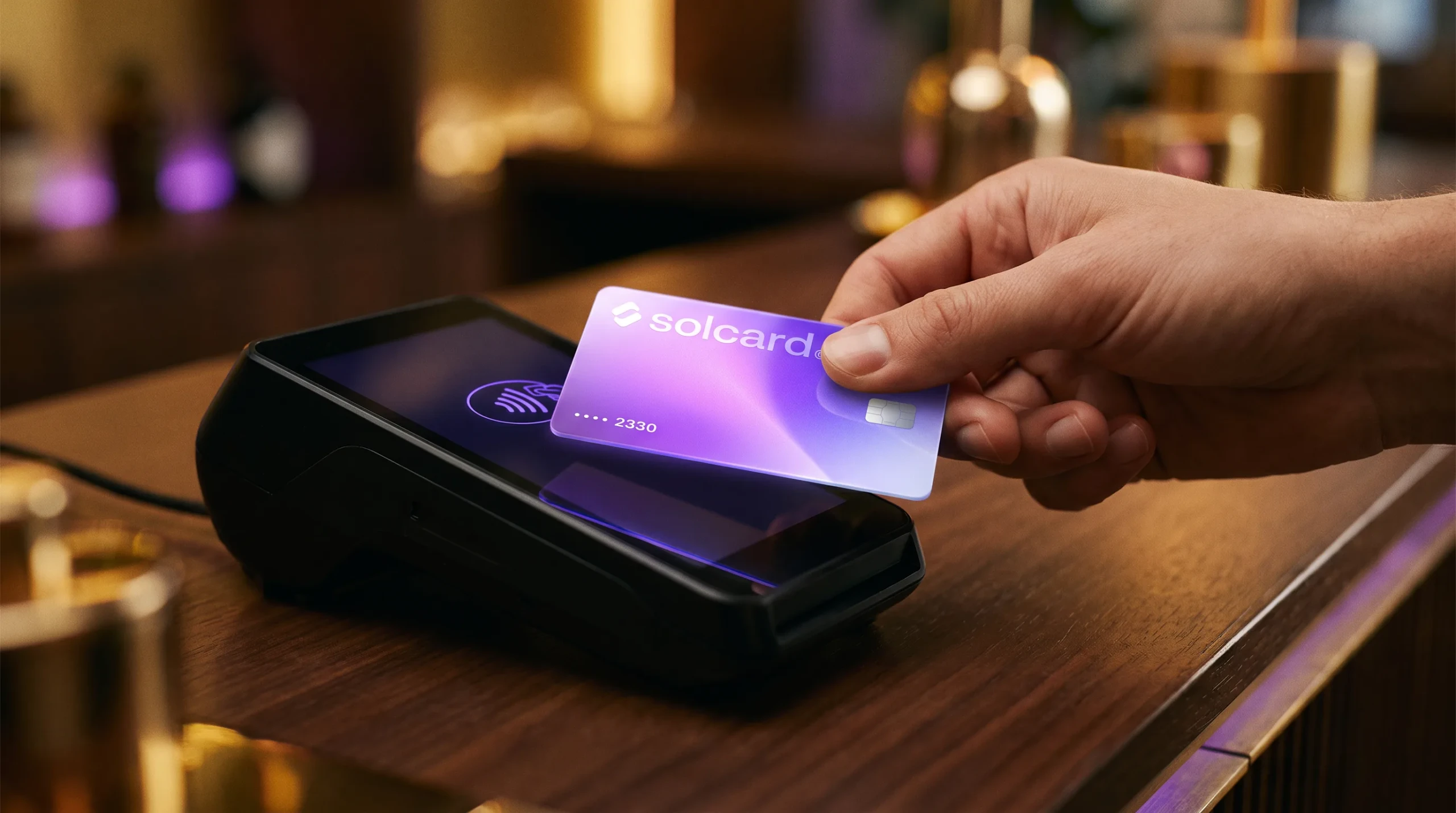
A crypto debit card lets you load funds straight from a self-custody wallet onto Visa or Mastercard rails, with no checking account behind it. The merchant receives normal dollars or euros and never touches cryptocurrency.
- Open a card account (no bank account and no credit check).
- Send USDC, USDT, SOL, or another supported asset from your wallet.
- Pay online, in-store, or via Apple Pay and Google Pay where supported.
Because the card runs on Visa or Mastercard, it works at 150M+ merchants across 200+ countries. You skip the exchange-to-bank off-ramp altogether. For a comparison of active providers, see our 2026 best crypto debit cards guide.
Services like Bitrefill, Coinsbee, and CoinGate let you buy digital gift cards for Amazon, Walmart, Uber, Apple, and hundreds of other retailers straight from your wallet. Delivery takes a few minutes and requires no bank account.
Gift cards are practical for a one-off purchase at a specific store, but the balance stays locked to that brand, codes are non-refundable once issued, and returns go back to store credit.
Some mobile payment apps let you top up a fiat balance from crypto and spend inside their merchant network or via an in-app virtual card. Availability varies sharply by country, so treat e-wallets as a local supplement rather than a global primary tool.
P2P marketplaces connect you directly with a buyer who pays in physical cash or local mobile money while an escrow contract holds your crypto. P2P works in markets where cards and exchanges have gaps, but it carries counterparty and scam risk. Never release escrow before verifying cleared payment.
Roughly 28,000 Bitcoin ATMs operate worldwide as of mid-2026 (down from about 39,000 at the end of 2025), per Coin ATM Radar. You scan a QR code, send crypto, and collect paper bills.
Bitcoin ATMs are the most expensive way to use crypto
Between machine operator fees and wide exchange spreads, Bitcoin ATMs routinely charge 10% to 25% above spot price. Reserve them for genuine emergencies when you must have paper bills in hand.
Most bank-free guides treat crypto as something you have to cash out into paper money first. That adds extra fees, delays, and security risks of carrying cash.
If you are buying groceries, booking flights, or paying monthly subscriptions, spending straight from a crypto-funded card is faster and cheaper. Save P2P and ATMs strictly for cash-only situations. For a broader look at all spending methods, read how to pay with crypto.
SolCard is a prepaid Visa and Mastercard card funded directly from your crypto wallet, with no bank account and no credit check. You can deposit SOL, USDC, USDT, and other supported tokens across 9+ networks including Solana, Ethereum, Base, and Polygon.
Both tiers have $0 monthly fees, a $10 one-time issuance fee per card, and a $0.30 per-transaction fee (see the SolCard fee breakdown and fees page):
- Virtual: online spending, $10,000/month limit, 5% top-up fee, 1-2% FX spread, and no identity verification required. Available in the US and most countries worldwide.
- Platinum: physical and virtual cards, Apple Pay and Google Pay, no monthly limit, 0% top-up fee, and 0-1.5% FX spread. Requires standard identity verification (KYC + liveness) and is available outside the US only.
Identity verification on Platinum is about card limits and mobile wallet eligibility, not linking a bank account. Your bank never sits between your wallet and checkout.
Use stablecoins to keep spending and taxes simple
In most countries, converting crypto to fiat is a taxable disposal even without a bank account involved. Loading USDC or USDT keeps your balance pegged to the dollar and keeps capital gains near zero. See our crypto spending and taxes guide.
Yes. A prepaid crypto debit card lets you spend at 150M+ Visa and Mastercard merchants without a checking account or credit check. Gift cards, e-wallets, P2P sales, and Bitcoin ATMs also work without a bank.
For everyday purchases, a 0% top-up crypto debit card like SolCard Platinum (outside the US, KYC verified) is far cheaper than Bitcoin ATMs (10% to 25%) or repeated gift card markups.
No. You open an account with your email and fund it directly from a crypto wallet across 9+ networks. Identity verification is only required for the Platinum tier (not for Virtual up to $10,000/month), and neither tier requires a bank account.
Use a Bitcoin ATM or a reputable P2P escrow marketplace for cash-in-hand. Both avoid banks, but ATMs carry 10% to 25% spreads and P2P requires careful counterparty vetting.
USDC and USDT are the most practical choices because they track the US dollar 1:1, avoiding daily price swings and simplifying tax reporting.
You do not need a traditional bank to live off crypto in 2026. Skip the 15% Bitcoin ATM markup: keep stablecoins in a self-custody wallet on a low-fee chain like Solana or Base, use a prepaid crypto card for 99% of daily spending, and use gift cards or P2P only for edge cases.