What Is a Crypto Debit (or Credit) Card and How It Works
What a crypto debit or prepaid card is, how it converts crypto to fiat at checkout, custodial vs self-custodial models, real fees, KYC rules, and tax basics.

In this article
A crypto debit card is a Visa or Mastercard funded by cryptocurrency instead of a bank account, converting your crypto balance into local fiat currency so you can pay at 150M+ merchants worldwide. The merchant receives ordinary dollars, euros, or pounds and never touches a blockchain.
People often search for both "crypto debit card" and "crypto credit card." In practice, almost every everyday crypto card (including SolCard, Coinbase Card, and Crypto.com Card) is a debit or prepaid card: you spend only what you load, with no credit line and no interest. A few products like Nexo Card offer a separate credit mode that borrows against crypto collateral.
- Open a card account. Depending on the provider and tier, you complete identity verification (KYC) or start on a capped unverified virtual tier.
- Deposit crypto or link a wallet. Send USDC, USDT, SOL, BTC, or ETH to your card account (or connect a self-custody wallet).
- Conversion to fiat happens in one of two ways:
- Pre-load (prepaid) model: Your crypto converts to USD or EUR when you deposit it, locking in your exact spending balance.
- At-sale model: Your crypto stays in tokens until you tap or swipe, converting at the checkout moment (your purchasing power moves with the market).
- Spend anywhere Visa or Mastercard works. Pay online with your virtual card, tap in-store via Apple Pay or Google Pay, or withdraw cash at an ATM with a physical card.
| Type | Who holds your funds | Pros | Trade-offs |
|---|---|---|---|
| Custodial / prepaid (SolCard, Coinbase, Crypto.com) | Card provider / issuing bank | Fast setup, multi-chain deposits, predictable fiat balance | Counterparty risk; subject to provider terms |
| Self-custodial (MetaMask Card) | Your own wallet until checkout | No pre-loaded custodial balance | Limited chains/tokens; you manage your own keys |
Virtual cards work immediately for online checkout and mobile wallets (where supported by the tier). Physical cards ship by mail and add chip-and-PIN terminals plus ATM cash withdrawals.
Every crypto card charges something. Watch the entire fee stack rather than a single "0% fee" headline:
| Fee type | Typical range | What catches people out |
|---|---|---|
| Top-up / conversion fee | 0% to 5% | Some "0% fee" cards hide a 1% to 2% spread in the exchange rate |
| Per-transaction fee | $0 to $0.30+ | Flat fees hit harder on frequent $5 purchases |
| Foreign exchange (FX) | 0% to 3% | Stacks on top of conversion fees when traveling abroad |
| ATM withdrawal | $0 to 2-3% | Plus whatever the local ATM operator charges |
| Issuance / annual fee | $0 to $199/year | Metal cards and physical card shipping can add upfront cost |
For real numbers across eight active providers, see our 2026 best crypto debit cards comparison.
What crypto cards do well: They let you spend crypto at 150M+ everyday merchants without waiting days for an exchange bank withdrawal, and they work without a traditional checking account or credit check.
Where they fall short:
- Taxes: In the US, the IRS classifies crypto as property, and brokers report disposals on Form 1099-DA starting with the 2026 tax year. Funding your card with USDC or USDT keeps capital gains near zero. See our crypto spending and taxes guide.
- Prepaid limits on holds: Hotels and car-rental agencies place large authorization holds that prepaid cards often decline. Stick to retail, dining, online shopping, subscriptions, and travel booked in full.
- Program changes: Card issuers regularly adjust fees, cashback caps, and supported countries (for example, MetaMask Card has paused new US/UK signups, and Binance Card now serves Brazil only).
Keep a balance buffer for subscriptions
Prepaid crypto cards have no bank overdraft. If your balance drops below a recurring Netflix, ChatGPT, or Spotify renewal, the charge declines immediately.
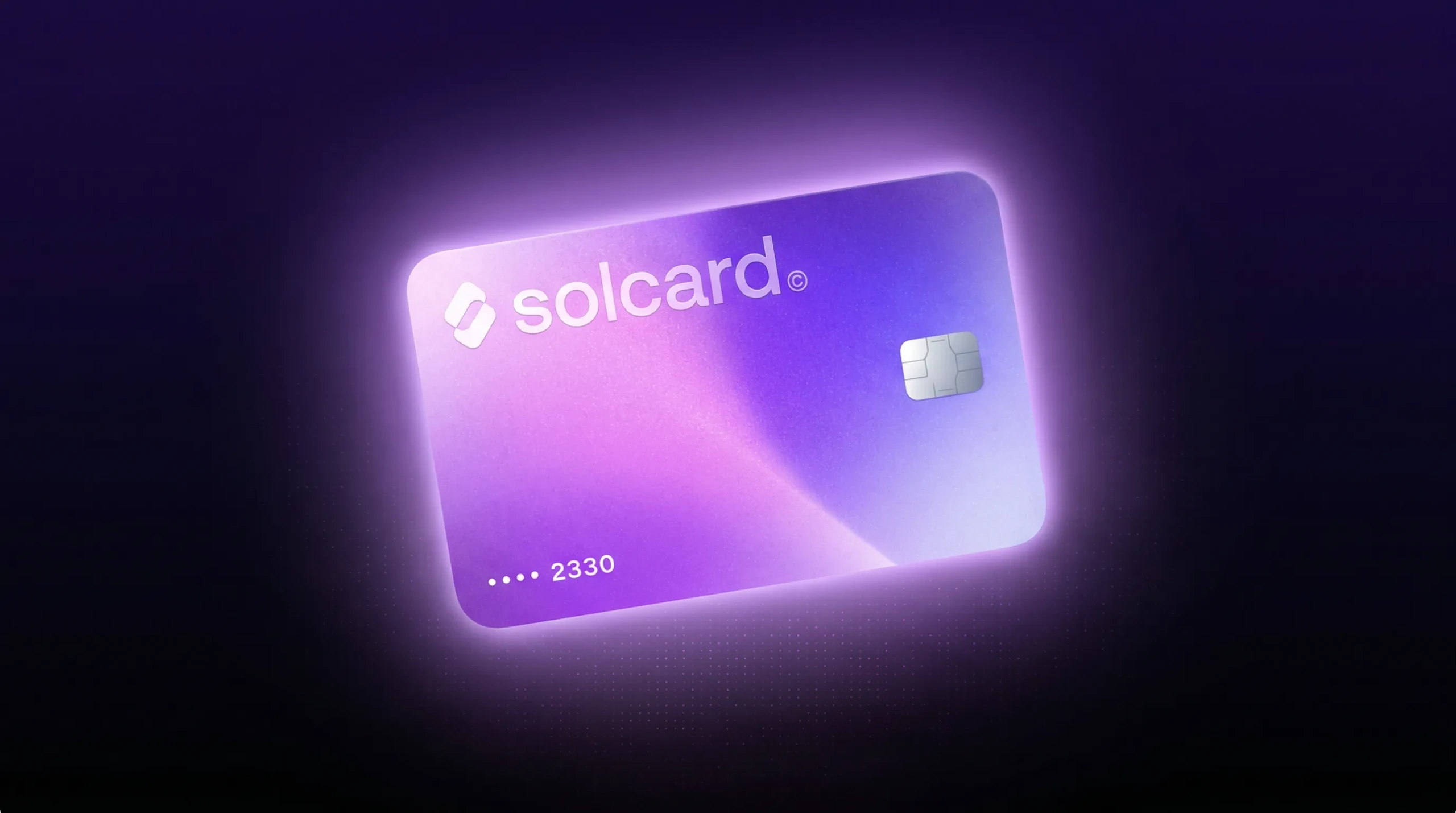
SolCard is a multi-chain prepaid Visa and Mastercard card funded straight from your crypto wallet across 9+ networks (Solana, Ethereum, Base, Polygon, and more), with no bank account and no credit check.
Both tiers charge $0/month, a one-time $10 issuance fee per card, and $0.30 per transaction (see the SolCard fee breakdown and fees page):
- Virtual: no identity verification required, $10,000/month limit, 5% top-up fee, 1-2% FX spread, online payments only. Available in the US and most countries worldwide.
- Platinum: identity verification required, 0% top-up fee, 0-1.5% FX spread, no monthly limit, multiple virtual cards plus physical access, and Apple Pay and Google Pay. Available outside the US only.
Compare SolCard head to head with Coinbase Card, RedotPay, MetaMask Card, or Nexo Card.
You load crypto (or link a wallet), the provider converts it into fiat currency either at deposit time or at checkout, and Visa or Mastercard settles a normal fiat payment to the merchant.
A crypto debit or prepaid card spends funds you already own, with no borrowing or interest. A crypto credit card (such as Nexo Card in Credit Mode) lends you fiat against crypto collateral you keep deposited.
Most crypto cards require full identity verification for all tiers, especially for mobile wallets and physical cards. SolCard offers an unverified Virtual tier capped at $10,000/month (5% top-up, online only), while its 0% top-up Platinum tier requires KYC.
Yes, if your tier includes a physical card. Virtual-only cards work online (and in Apple/Google Pay if enrolled) but cannot withdraw cash at ATMs.
Yes, though selection is narrower than in Europe. Coinbase Card and Crypto.com Card serve US residents, and SolCard offers its Virtual tier in the US (Platinum is outside the US only). Nexo Card, RedotPay, and Binance Card are not available in the US.
A crypto debit card is not a new payment network; it is a bridge from your wallet onto Visa and Mastercard. Pick a card that supports your country and your preferred chains, verify the total fee stack (top-up + spread + FX), and load stablecoins for day-to-day spending so taxes and volatility stay out of your way. For all five ways to spend digital assets, see how to pay with crypto.