SolCard vs BitPay Card: Which Crypto Card Is Right for You?
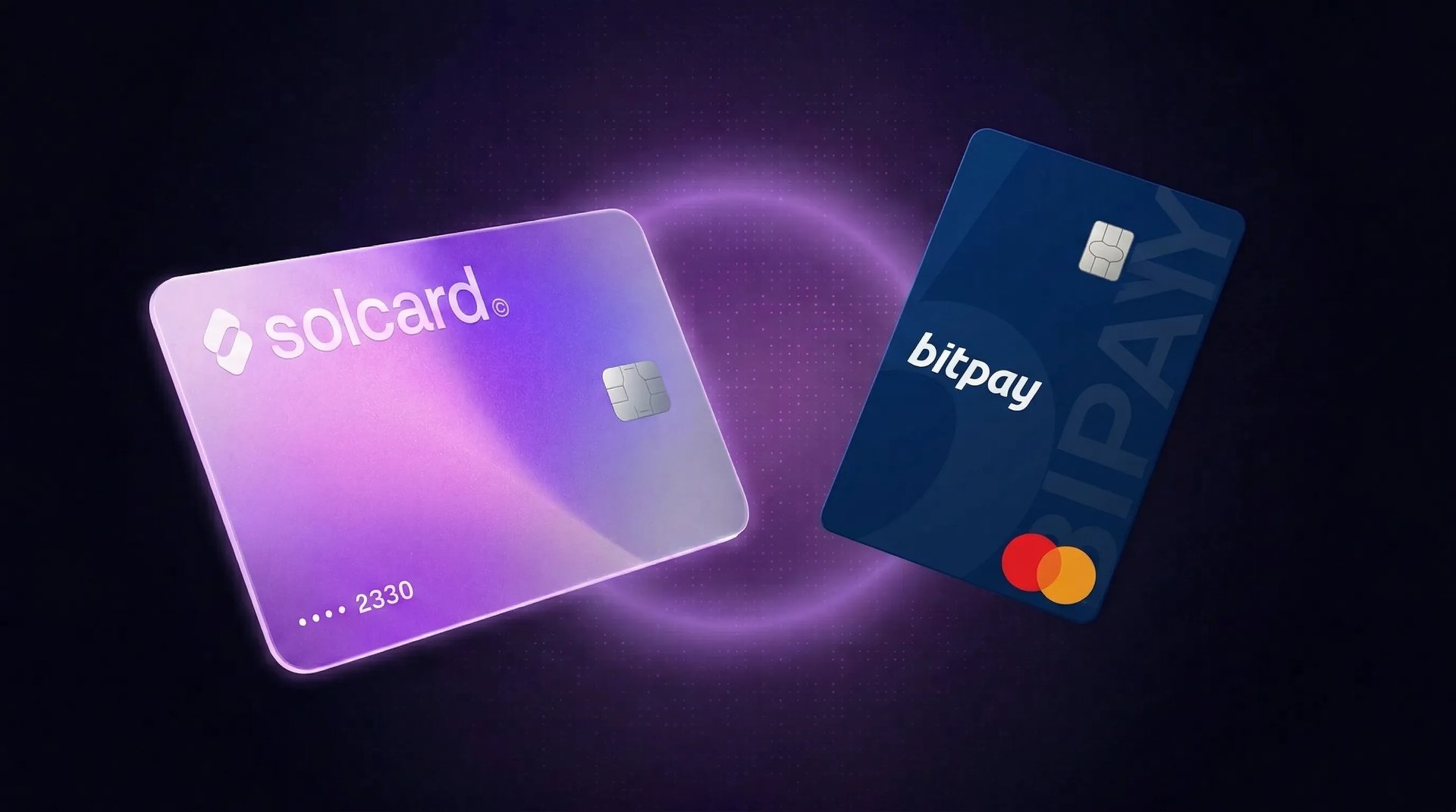
BitPay is one of the longest-running names in crypto payments, operating since 2011 and offering a prepaid Mastercard that lets US residents spend Bitcoin and other cryptocurrencies at merchants worldwide. SolCard takes a different approach, built natively on Solana with a no-verification tier, low transparent fees, and multichain stablecoin support.
Both cards convert crypto to fiat for everyday spending, but the similarities end there. This comparison breaks down fees, privacy, supported assets, availability, and rewards so you can decide which card fits your needs.
| Feature | SolCard | BitPay Card |
|---|---|---|
| Card Network | Visa and Mastercard | Mastercard |
| Card Type | Virtual (add to Apple Pay / Google Pay on Full Access tier) | Virtual and Physical |
| KYC Required | No (Standard tier); Yes (Full Access tier) | Yes (mandatory for all users) |
| Top-up Fee | 0% (Full Access) or 5% (Standard) | 0% (crypto conversion in US) |
| FX Fee | 2% | 3% |
| Monthly Fee | $0 | $0 ($5 inactivity fee per 90 days) |
| Card Issuance | $10 | $10 |
| ATM Withdrawal | N/A (virtual only) | $2.50 per withdrawal |
| Supported Crypto | SOL, USDC, USDT, SOLC, JITO + multichain stablecoins | BTC, ETH, BCH, LTC, DOGE, SHIB, XRP, USDC, DAI + more |
| Blockchain | Solana-native (+ 9 chains for stablecoins) | Bitcoin, Ethereum, and others (100+ coins via BitPay wallet) |
| Cashback | None (low-fee model) | Up to 15% at select merchants (via Cardlytics) |
| Daily Spend Limit | Up to $5,000/mo (Standard) | $10,000/day |
| Regions | 150M+ merchants globally (US excluded) | US only (usable internationally) |
| Apple Pay / Google Pay | Yes (Full Access tier) | Yes (Apple Pay confirmed) |
| New Applications | Open | Paused (waitlist only) |
SolCard is a crypto-funded virtual prepaid card built on the Solana blockchain. You deposit SOL, USDC, USDT, or SOLC, the crypto is converted to USD, and you receive a virtual card that works anywhere Visa or Mastercard is accepted. Cards are issued in approximately 18 seconds and can be added to Apple Pay or Google Pay on the Full Access tier.
- No-Verification option. The Standard tier allows spending up to $5,000 per month without any identity verification, a meaningful differentiator in a market that increasingly requires full KYC.
- Solana-native with multichain support. Direct deposits of SOL and Solana-based tokens, plus stablecoin deposits across Ethereum, Polygon, BSC, Arbitrum, Optimism, Avalanche, Base, and other networks.
- Instant issuance. No approval wait. Create an account, fund it, and start spending in under a minute.
- Two-tier access. Choose between the no-verification Standard tier for quick access or the Full Access tier with Apple Pay, Google Pay, and 0% top-up fees.
- Virtual card only (no physical card or ATM access)
- No-Verification Standard tier carries a 5% top-up fee
- Not available to US residents
- No native Bitcoin or Ethereum deposit support (swap to stablecoins required)
BitPay is a crypto payment company founded in 2011 that offers a prepaid Mastercard for converting and spending cryptocurrency. The card connects to the BitPay self-custody wallet, which supports 100+ coins and tokens. When you load the card, your crypto is converted to US dollars at the current exchange rate with no conversion fee for US residents.
- Established track record. BitPay has operated since 2011, making it one of the oldest and most trusted names in crypto payments.
- Broad crypto support. The BitPay wallet supports BTC, ETH, BCH, LTC, DOGE, SHIB, XRP, USDC, DAI, and dozens more tokens across multiple networks including Arbitrum, Optimism, and Base.
- No conversion fees in the US. Converting crypto to dollars and loading the card costs nothing for US residents, though mining and network fees still apply.
- Physical card available. Unlike virtual-only alternatives, BitPay offers a physical card for in-store purchases and ATM withdrawals up to $6,000 per day.
- Apple Pay integration. BitPay cardholders can link their card to Apple Pay for contactless mobile payments.
- Bill Pay feature. Pay credit card statements, mortgages, student loans, and other bills directly with crypto through the BitPay app.
- New applications are currently paused. BitPay has temporarily suspended new card signups while transitioning to a new banking partner. A waitlist is available.
- US residents only (card cannot be issued internationally)
- Full KYC is mandatory, including government ID, selfie verification, and SSN for US residents
- $5 inactivity fee if the card goes unused for 90 days
- 3% foreign transaction fee when used outside the US
- Mining and network fees on card loads can be significant, especially for Bitcoin transactions
- Customer support has been reported as slow by some users
Fee structures are one of the most important differences between these two cards, and the better deal depends heavily on how you plan to use it.
For the no-verification Standard tier, there is a 5% top-up fee when loading your card. The Full Access tier (which requires KYC) eliminates the top-up fee entirely, with only a 2% fee on non-USD purchases. There is a $10 one-time issuance fee for both card tiers.
BitPay's headline advantage is zero conversion fees for US residents when loading crypto onto the card. There is no per-transaction fee and no monthly fee. However, mining and network fees are added when moving funds onto the card, and these vary based on blockchain congestion. ATM withdrawals cost $2.50 each, and international purchases incur a 3% foreign transaction fee. The card costs $10 to issue, and there is a $5 inactivity fee charged every 90 days if the card is not used.
For a single $100 USD purchase funded with crypto (ignoring network fees):
- SolCard (Full Access): $0.00 total
- SolCard (no-verification): $5.00 top-up fee = $5.00 total
- BitPay Card: $0.00 = $0.00 total
For frequent, smaller purchases (30 transactions of $20 each in a month):
- SolCard (Full Access): $0.00 total
- SolCard (no-verification): $30.00 top-up fee = $30.00 total
- BitPay Card: $0.00 = $0.00 total (plus variable network fees on card loads)
Both cards offer zero-fee transactions on their primary tiers. BitPay has no conversion fees for US residents, while SolCard's Full Access tier has no top-up fees. In practice, BitPay's variable mining and network fees when loading crypto onto the card can add up, especially during periods of high blockchain congestion. Some users have reported paying substantial network fees on Bitcoin loads. SolCard's Full Access tier offers predictable, transparent pricing with no monthly fees, which can be an advantage for budgeting.
This is one of the most significant differentiators between these two cards and often the deciding factor for privacy-conscious crypto users.
SolCard is one of the few remaining crypto cards that offers a functional no-verification tier. The Standard card lets you spend up to $5,000 per month without submitting any personal information. No government ID, no selfie, no proof of address, and no SSN.
The trade-off is a 5% top-up fee and no Apple Pay or Google Pay on the no-verification tier. The Full Access tier requires standard identity verification but drops the top-up fee to 0%.
BitPay requires identity verification for all card users. The process includes providing your full legal name, date of birth, residential address, a government-issued photo ID (passport, driver's license, or state ID), and a live selfie for facial verification through Onfido. US residents must also provide their Social Security Number. In some cases, proof of address (utility bill or bank statement from the last 90 days) may also be required.
There is no way to use the BitPay Card without completing this process. BitPay is required by applicable laws and regulations to collect this information for any card-related transactions.
Bottom line: If spending crypto without identity verification matters to you, SolCard is the only option between these two. BitPay requires full KYC with no exceptions for card users.
SolCard is built on Solana and natively supports SOL, USDC, USDT, SOLC, and JITO. It also accepts multichain stablecoin deposits across 9+ networks including Ethereum, Polygon, BNB Smart Chain, Arbitrum, Optimism, Avalanche, and Base. This means you can deposit USDC or USDT from most major chains, even if you are not primarily a Solana user.
SolCard does not support direct Bitcoin or Ethereum deposits. If you hold BTC or ETH, you would need to swap to a supported stablecoin before depositing.
BitPay supports one of the broadest cryptocurrency selections of any crypto card. Through the BitPay wallet, users can hold and convert BTC, ETH, BCH, LTC, DOGE, SHIB, XRP, WBTC, UNI, BNB, LINK, CRO, BAT, and many more. The wallet supports 100+ coins and tokens across multiple blockchain networks, including newer Layer 2 networks like Arbitrum, Optimism, and Base. BitPay also supports five USD-pegged stablecoins: USDC, DAI, GUSD, USDP, and BUSD.
The major advantage here is native Bitcoin support. Bitcoin holders can load BTC directly onto the card without first swapping to a stablecoin.
Bottom line: BitPay wins on raw cryptocurrency breadth, especially for Bitcoin, Ethereum, and altcoin holders. SolCard is the better choice for Solana ecosystem users and those who primarily hold stablecoins across multiple chains.
SolCard works at over 150 million merchants worldwide through the Visa and Mastercard networks. It is accessible to users globally, though the US is currently a restricted region. SolCard supports users in 200+ countries, with a small number of restricted nations including the US, Cuba, Iran, Syria, and North Korea.
BitPay Card is currently only available to US residents and cannot be issued to users in other countries. However, once you have the card, it can be used internationally wherever Mastercard is accepted, with a 3% foreign transaction fee on non-USD purchases. BitPay previously offered an international card in 131 countries back in 2017 through a Visa partnership, but that program was discontinued. The company has indicated plans to expand internationally again, but no timeline has been announced.
It is important to note that BitPay has paused new card applications as of early 2025 while transitioning to a new banking partner. Existing cardholders can continue using their cards, but new users cannot sign up and must join a waitlist.
Bottom line: SolCard is accessible in most countries worldwide and currently accepting new users, though the US is excluded. BitPay is limited to the US and is not accepting new applications at this time. Neither card currently serves both US and international users simultaneously.
SolCard does not offer a cashback or rewards program. Instead, it focuses on low fees and broad merchant acceptance as its core value proposition.
BitPay partnered with Cardlytics (through Dosh) to offer merchant-specific cashback. Cardholders were automatically enrolled and could earn up to 15% cash back at participating retailers such as Adidas, Costco, Sam's Club, Shake Shack, H&M, Office Depot, and others across 100,000+ locations. The cashback was credited directly to the card balance.
However, these rewards are not a flat rate on all purchases. The percentage varies by merchant and offer availability, meaning cashback is inconsistent and depends on where you shop. There is no guaranteed cashback on every transaction.
Given that the card program is currently paused, the future of the rewards program under a new banking partner is uncertain.
Bottom line: SolCard does not offer cashback, instead focusing on low fees and broad acceptance. BitPay's merchant-specific cashback can reach up to 15% at select stores but is inconsistent and may not be available in the relaunched program.
SolCard prioritizes speed and simplicity. Account creation takes minutes, card issuance happens in about 18 seconds, and the dashboard is clean. The no-verification flow is especially fast since there is no verification wait. Adding the card to Apple Pay or Google Pay (Full Access tier) enables seamless contactless payments. The lack of a physical card is the main UX trade-off, ruling out ATM withdrawals.
BitPay offers a mature mobile app available on iOS and Android, plus a desktop dashboard. The self-custody wallet gives users full control of their private keys with a 12-word recovery phrase. Features like Bill Pay (for mortgages, student loans, and credit cards) and the ability to buy crypto directly in the app add utility beyond just card spending. The physical card option provides ATM access with a generous $6,000 daily withdrawal limit.
On the downside, BitPay's mandatory KYC process adds friction to onboarding, including selfie verification and SSN entry for US residents. Some users have reported slower customer support response times and occasional account lock issues. The self-custody model also means losing your recovery phrase means losing your funds permanently.
Choose SolCard if you:
- Hold SOL, USDC, or USDT on Solana or other supported chains
- Value privacy and want to spend crypto without KYC
- Primarily need a virtual card for online purchases and mobile payments
- Want the fastest possible onboarding with no verification delays
- Live outside the United States
Choose BitPay if you:
- Hold Bitcoin, Ethereum, or a wide variety of altcoins
- Need a physical card for ATM withdrawals
- Want zero conversion fees on crypto-to-fiat loading (US only)
- Are a US resident comfortable with full identity verification
- Value an established brand with over a decade of operations
- Need Bill Pay functionality for recurring bills
For a broader look at how these and other crypto cards compare, check out our best crypto debit cards roundup.
The BitPay Card has no monthly fee and no per-transaction fee for US purchases. The card costs $10 to issue. ATM withdrawals cost $2.50 each, and international transactions carry a 3% foreign exchange fee. There is also a $5 inactivity fee charged every 90 days if the card is not used. While crypto-to-fiat conversion is free for US residents, variable mining and network fees apply when loading crypto onto the card.
As of early 2025, BitPay has paused new card applications while transitioning to a new banking partner. Existing cardholders can continue using their cards, but new users cannot currently sign up. BitPay offers a waitlist for updates on when the card program relaunches. SolCard is currently accepting new users without a waitlist.
Yes. BitPay requires full identity verification for all card users, including a government-issued photo ID, live selfie verification, and Social Security Number for US residents. There is no way to use the BitPay Card without completing KYC. SolCard's Standard tier, by contrast, allows spending up to $5,000 per month with no identity verification.
BitPay supports a broad range of cryptocurrencies including BTC, ETH, BCH, LTC, DOGE, SHIB, XRP, and stablecoins like USDC, DAI, GUSD, and USDP. The BitPay wallet supports 100+ coins and tokens across multiple blockchain networks. SolCard supports SOL, USDC, USDT, SOLC, and JITO natively on Solana, plus multichain stablecoin deposits across 9+ networks.
SolCard does not offer a cashback or rewards program, focusing instead on low fees and broad acceptance. BitPay offered up to 15% cashback at select participating merchants through its Cardlytics partnership, but this was not a flat rate on all purchases and varied by merchant. With BitPay's card program currently paused, the future of its rewards program is uncertain.
The BitPay Card can only be issued to US residents, but once you have it, you can use it internationally wherever Mastercard is accepted. International purchases incur a 3% foreign transaction fee. SolCard is accessible to users in 200+ countries but does not currently support US residents.
Yes. BitPay Card supports Apple Pay for US-based cardholders, allowing contactless tap-to-pay at retail locations. SolCard's Full Access tier also supports Apple Pay and Google Pay, though the no-verification Standard tier does not include mobile wallet integration.
BitPay is the better option for Bitcoin holders. It supports native BTC deposits and converts Bitcoin to USD with no conversion fee for US residents. SolCard does not support direct Bitcoin deposits. BTC holders would need to swap to a supported stablecoin (like USDC or USDT) before depositing to SolCard, which adds an extra step and potential swap fees.
SolCard and BitPay serve distinct segments of the crypto card market, and the right choice depends largely on what you hold, where you live, and how much you value privacy.
BitPay brings a proven track record, broad cryptocurrency support (especially for Bitcoin), zero conversion fees for US residents, a physical card with ATM access, and useful extras like Bill Pay. For US-based Bitcoin holders who are comfortable with full KYC, it has been a reliable option for years. However, the card program is currently paused with no confirmed relaunch date, it is limited to US residents, and it requires extensive identity verification.
SolCard stands out with its no-verification Standard tier, broad international availability, Solana-native design, and low transparent fees. It is currently open for new users, issues cards in seconds, and supports multichain stablecoin deposits. The trade-offs are a 5% top-up fee on the no-verification tier, no physical card, no US availability, and no native Bitcoin support.
For Solana ecosystem users, privacy-conscious spenders, and anyone outside the United States, SolCard is the clear choice. For US-based Bitcoin and altcoin holders who value an established brand and physical card access, BitPay remains a strong contender once it reopens its card program. Note that these two cards serve largely different geographic markets, with SolCard covering international users and BitPay serving the US.