SolCard vs RedotPay: Which Crypto Card Is Better in 2026?
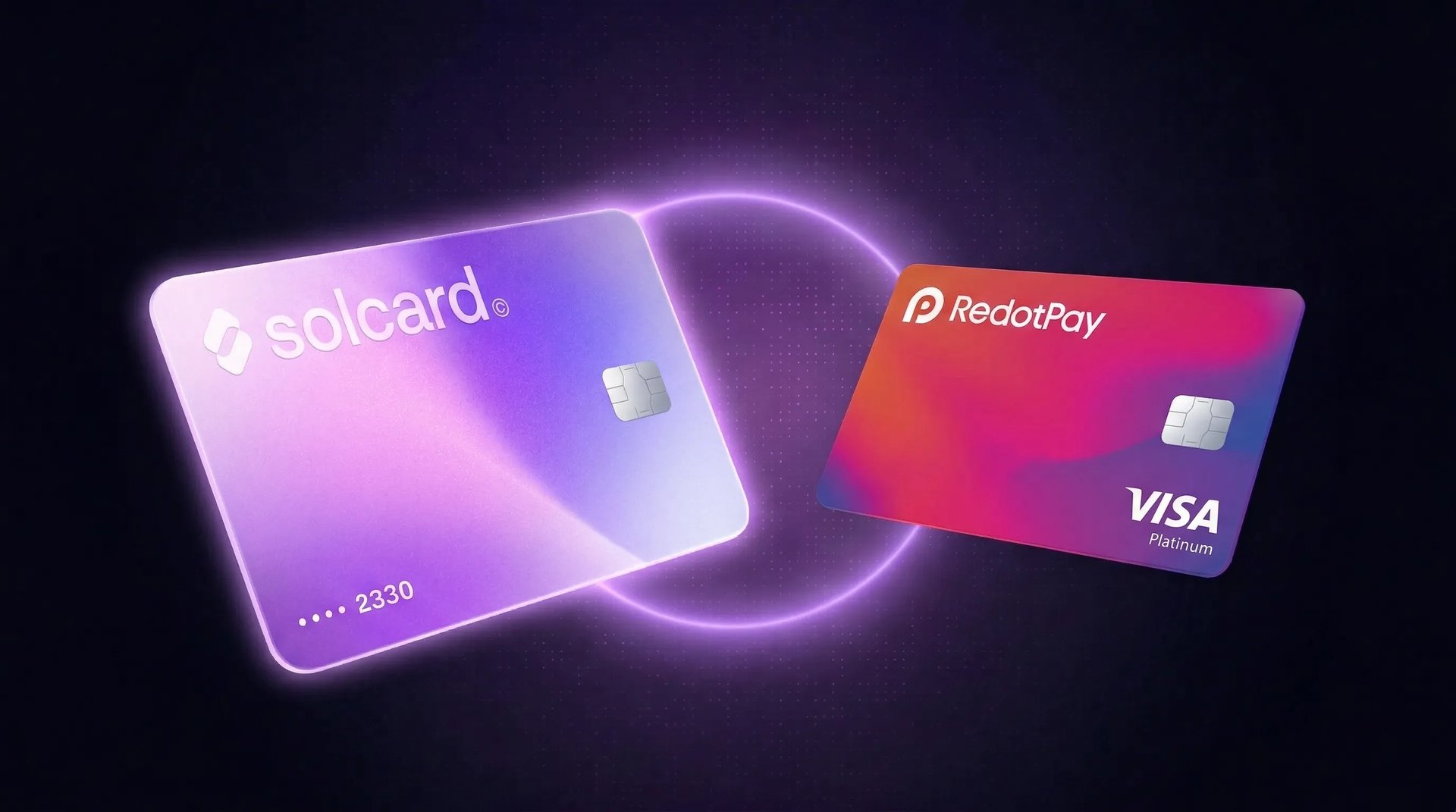
If you are looking for a crypto debit card to spend your digital assets in the real world, SolCard and RedotPay are two of the most talked-about options. Both let you convert crypto to fiat and spend at millions of merchants worldwide, but they take very different approaches to fees, privacy, supported assets, and user experience.
This comparison breaks down how each card works, what they cost, and which one makes more sense depending on your situation.
| Feature | SolCard | RedotPay |
|---|---|---|
| Card Network | Visa and Mastercard | Visa |
| Card Type | Virtual and Platinum (physical) | Virtual and Physical |
| KYC Required | No (Virtual); Yes (Platinum) | Yes (mandatory for all users) |
| Top-up Fee | 0% (Platinum) or 5% (Virtual/no-verification) | 0% (crypto deposit); 3% (credit/debit card) |
| Transaction Fee | None | 1% crypto conversion |
| FX Fee | 1–2% | 1.2% |
| Monthly Fee | $0 | $0 |
| Card Issuance | $10 | $10 (virtual) / $100 (physical) |
| Supported Crypto | SOL, USDC, USDT, SOLC, JITO + multichain stablecoins | BTC, ETH, USDT, USDC |
| Blockchain | Solana-native (+ 9 chains for stablecoins) | Ethereum, Tron, BSC, Polygon, Bitcoin |
| Rewards | No cashback program | None (promotional rewards only) |
| Monthly Spend Limit | Up to $5,000 (no-verification) / Unlimited (Platinum) | Up to $50,000/day (after full KYC) |
| Regions | 150M+ merchants in 200+ countries | 160+ countries, 130M+ merchants |
| Apple Pay / Google Pay | Yes (Platinum tier) | Yes |
SolCard is a crypto-funded prepaid card built on the Solana blockchain. You deposit SOL, USDC, USDT, or SOLC, the crypto is converted to USD, and you get a card that works anywhere Visa or Mastercard is accepted. The Platinum tier includes a physical card and can be added to Apple Pay or Google Pay. Cards are issued in about 18 seconds.
- No-Verification option. The Virtual card tier does not require identity verification for spending up to $5,000 per month, a meaningful differentiator in a market where most cards now require full KYC.
- Solana-native. Direct deposits of SOL and Solana-based tokens, plus multichain stablecoin deposits across Ethereum, Polygon, BSC, Arbitrum, Optimism, Avalanche, Base, and others.
- Instant issuance. No waiting for approval. Create an account, fund it, and start spending.
- No-Verification Virtual tier carries a 5% top-up fee
- Platinum tier requires identity verification
- The United States is listed as a restricted country
RedotPay is a Hong Kong-based crypto payment platform with over 5 million users across 160+ countries. After completing KYC, you deposit BTC, ETH, USDT, or USDC to your wallet. Crypto is converted to fiat at the point of sale, and the card works at any Visa-accepting merchant.
- Physical card available. RedotPay offers a physical Visa card for in-store purchases and ATM withdrawals.
- High spending limits. Up to $100,000 per transaction and $1,000,000 per day after full KYC.
- Bitcoin support. BTC deposits are supported directly, so Bitcoin holders can spend without swapping to a stablecoin first.
- No monthly fees. No monthly or annual fees, a clear advantage for infrequent users.
- Earn feature. Subscribe your crypto holdings to earn daily rewards with flexible withdrawal.
- KYC is mandatory for all users
- No cashback rewards on card spending
- Physical card costs $100 to issue
- 1% conversion fee on every crypto-funded transaction
- Some subscription services may not work with RedotPay cards
Fees are where these two cards diverge significantly, and the right choice depends on how you plan to use the card.
For the no-verification Virtual tier, there is a 5% top-up fee when loading your card. The Platinum (KYC-verified) tier eliminates the top-up fee entirely, with only a 1–2% fee on non-USD purchases.
There is a $10 issuance fee for the card. No monthly or annual fees are charged.
RedotPay charges a 1% conversion fee on all crypto-to-fiat transactions, a 1.2% foreign exchange markup on non-default currency purchases, and a 2% fee for ATM withdrawals. Crypto deposits to your RedotPay wallet are free, but topping up via a traditional credit or debit card incurs a 3% fee.
The virtual card costs $10, and the physical card costs $100. There are no monthly or annual fees.
For a single $100 USD purchase funded with crypto:
- SolCard (Platinum): No transaction fee = $0.00 total
- SolCard (no-verification): $5.00 top-up fee = $5.00 total
- RedotPay: $1.00 conversion fee = $1.00 total
For frequent, smaller purchases (say, 30 transactions of $20 each in a month):
- SolCard (Platinum): No transaction fees = $0.00 total
- SolCard (no-verification): $30.00 top-up fee = $30.00 total
- RedotPay: $6.00 in conversion fees = $6.00 total
The takeaway: SolCard Platinum is the cheapest option with no per-transaction fees. RedotPay's 1% conversion fee adds up over time, especially for frequent spenders. The no-verification SolCard tier is more expensive due to its 5% top-up fee, but offers something the others do not: privacy.
This is one of the biggest differentiators between these two cards, and for many crypto users, it is the deciding factor.
SolCard is one of the few remaining crypto cards with a functional no-verification tier. The Virtual card lets you spend up to $5,000 per month without submitting any personal information. No ID, no selfie, no proof of address.
The trade-off is a 5% top-up fee and no Apple Pay or Google Pay on the no-verification tier. The Platinum tier requires standard identity verification but drops the top-up fee to 0% and unlocks unlimited monthly spending.
RedotPay requires identity verification for all users: government-issued ID, selfie with liveness detection, and sometimes proof of address. The process uses Sumsub (the same provider Binance uses) and typically takes a few minutes.
Without KYC, RedotPay caps you at $500 lifetime spending with email-only registration, which is unusable for any real spending.
Bottom line: If spending crypto without identity verification matters to you, SolCard is the clear choice.
SolCard is built on Solana and natively supports SOL, USDC, USDT, SOLC, and JITO. It also accepts multichain stablecoin deposits across 9+ networks including Ethereum, Polygon, BNB Smart Chain, Arbitrum, Optimism, Avalanche, Base, and HyperEVM. This means you can deposit USDC or USDT from most major chains, even if you are not a Solana user.
That said, SolCard does not support Bitcoin or Ethereum deposits directly. If you hold BTC or ETH and want to use SolCard, you would need to swap to a supported stablecoin first.
RedotPay supports BTC, ETH, USDT, and USDC across Ethereum, Tron, BSC, Polygon, and the Bitcoin network. The major advantage here is native Bitcoin support. You can deposit BTC directly and spend it without first converting to a stablecoin.
However, RedotPay does not support Solana-based tokens, so SOL holders would need to bridge or swap assets before depositing.
Bottom line: SolCard is better for Solana ecosystem users and stablecoin holders. RedotPay is better for Bitcoin and Ethereum holders who want direct deposit support.
SolCard works at over 150 million merchants in 200+ countries anywhere Visa or Mastercard is accepted, covering Europe, Asia, Oceania, Latin America, and parts of Africa. Notable restricted countries include the United States, Russia, and several others due to international regulations.
RedotPay operates in 160+ countries, though notable exclusions include Australia, Japan, Singapore, and Cambodia. Physical card delivery is limited to select countries.
Both cards may experience declines at individual merchants depending on merchant policies. RedotPay users have reported issues with certain subscription services.
SolCard does not offer a cashback or rewards program. Its value proposition centers on low fees, broad merchant acceptance, and privacy through its no-verification tier.
RedotPay does not offer a traditional cashback program on card spending. Instead, it provides an "Earn" feature that lets you subscribe your crypto holdings for daily rewards with no lock-up period. This functions more like a flexible savings account than a spending reward.
RedotPay also runs a referral program offering up to 40% commission on referred users' transactions, along with occasional promotional cashback offers.
Bottom line: Neither card offers traditional cashback on spending. RedotPay's Earn feature is useful for idle funds but does not reward active card usage. SolCard competes on low fees and privacy rather than rewards.
SolCard prioritizes speed and simplicity. Account creation takes minutes, the card is issued in seconds, and the dashboard is clean. The no-verification flow is especially fast. Adding the Platinum card to Apple Pay or Google Pay makes in-store payments seamless.
RedotPay offers a polished mobile app on iOS and Android with crypto deposits, card management, the Earn feature, and multi-currency accounts supporting GBP and EUR. The physical card adds flexibility for ATM withdrawals. However, mandatory KYC adds friction to onboarding, and some users have reported delays with customer support around refunds and account reviews.
Choose SolCard if you:
- Hold SOL, USDC, or USDT on Solana
- Value privacy and want to spend without KYC
- Primarily need a virtual card for online purchases and mobile payments
- Want the fastest possible onboarding
Choose RedotPay if you:
- Hold BTC or ETH and want to spend them directly
- Need a physical card for ATM withdrawals
- Require very high spending limits ($100K+ per transaction)
- Do not mind completing identity verification
- Prefer a dedicated mobile app on iOS and Android
For a broader look at how these and other crypto cards compare, check out our best crypto debit cards roundup.
It depends on your usage. SolCard Platinum (with KYC) has no transaction fees and no top-up fee, making it the cheapest option overall. RedotPay charges 1% per transaction, which adds up for frequent spenders. The no-verification SolCard Virtual tier is the most expensive due to its 5% top-up fee.
Yes. RedotPay requires full identity verification for all users who want meaningful spending limits. Without KYC, you are limited to $500 lifetime spending, which is not practical for regular use.
Yes. SolCard's Virtual card tier allows spending up to $5,000 per month without any identity verification. The trade-off is a 5% top-up fee and no access to Apple Pay or Google Pay.
No. RedotPay supports BTC, ETH, USDT, and USDC on Ethereum, Tron, BSC, Polygon, and Bitcoin networks. Solana is not currently supported.
Neither card offers traditional cashback on spending. SolCard focuses on low fees and privacy rather than rewards. RedotPay does not have a cashback program either, though it offers daily crypto earnings through its Earn feature and occasional promotional rewards.
SolCard offers both a Virtual card (no-verification) and a Platinum card that includes a physical card for in-store and online use. The Platinum tier also supports Apple Pay and Google Pay for contactless payments. RedotPay similarly offers both virtual ($10) and physical ($100) cards.
SolCard currently lists the United States as a restricted country. RedotPay supports US users after KYC, though some features may be limited. Check each provider's website for the latest regional availability.
SolCard and RedotPay serve different segments of the crypto card market. SolCard stands out for its no-verification option, Solana-native design, and low fees. It is the better fit for Solana users, privacy-conscious spenders, and anyone who values fast onboarding and simplicity.
RedotPay is a strong choice for Bitcoin holders, high-volume spenders, and users who need a physical card with ATM access. Its higher transaction limits and broader crypto support make it practical for heavy use.
Neither card is perfect. SolCard's no-verification tier is expensive at 5%, and certain countries including the US are restricted. RedotPay's mandatory KYC leaves gaps for privacy-minded users.
The right choice comes down to what you hold, how you spend, and how much you value privacy. For Solana ecosystem users who want minimal friction and low fees, SolCard is the stronger option.