Is SolCard Legit? An Honest 2026 Review of Fees, KYC & Limits
An honest 2026 look at SolCard from the SolCard team: real fees, Virtual vs Platinum tiers, US and country limits, safety caveats, and when another card fits better.

In this article
Yes, SolCard is a real, active prepaid Visa and Mastercard card funded from crypto wallets, not a scam. Because we are the SolCard team writing this, you should still check our published fees, country limits, and trade-offs yourself before loading a dollar.
"Legit" does not automatically mean "best for you." Below is the straight breakdown of how SolCard works, every fee we charge, where our tiers fall short, and when a competitor is the smarter pick.
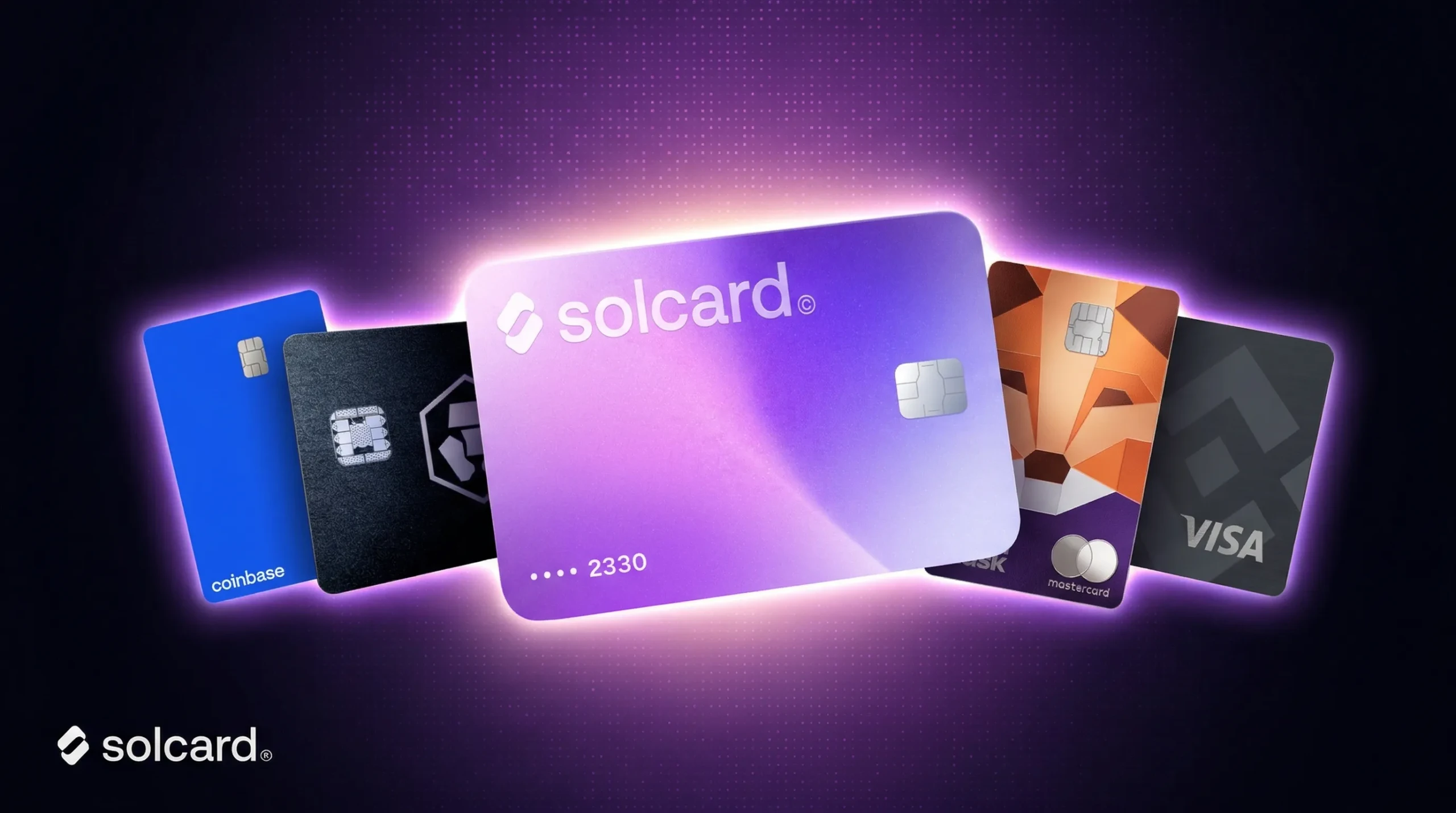
SolCard is a prepaid Visa and Mastercard card funded directly from your crypto wallet, with no bank account and no credit check. You deposit SOL, USDC, USDT, or other supported tokens across 9+ networks including Solana, Ethereum, Base, and Polygon. Deposits convert to USD, and you spend at 150M+ merchants in 200+ countries.
It is not a credit card (no credit line, no borrowing), and it does not have a cashback program.
Every fee is published on our fees page and in the SolCard fee breakdown:
| Item | Virtual | Platinum |
|---|---|---|
| Form factor | Virtual only (online) | Physical + multiple virtual, Apple Pay & Google Pay |
| Issuance fee | $10 per card | $10 per card |
| Top-up fee | 5% | 0% |
| Per-transaction fee | $0.30 | $0.30 |
| FX spread | 1-2% | 0-1.5% |
| Monthly fee | $0 | $0 |
| Monthly limit | $10,000 | No limit |
| Identity verification | Not required | Required (KYC + liveness) |
| US availability | Yes | Not available in the US |
Be realistic about the math: the Virtual tier's 5% top-up fee is expensive for large loads. On $20 it is $1; on $1,000 it is $50. If you live outside the US and spend regularly, verifying for Platinum (0% top-up) pays for itself immediately.
Check regional rules before signing up
SolCard serves most countries worldwide, but Platinum is not available to US residents (US users can use the online-only Virtual tier). Restricted jurisdictions include Cuba, North Korea, Egypt, Iran, Myanmar, Nigeria, Russia, South Africa, Syria, Ukraine, Venezuela, Belarus, and Hong Kong.
Here is what is true and what is not:
- Real card networks: Transactions clear on Visa and Mastercard rails with standard card-network fraud monitoring and 3D Secure support.
- Not a bank account: SolCard is a prepaid crypto card program, not an FDIC-insured bank. Treat your loaded card balance like spending money for the week or month, not long-term savings, and keep your email login protected with strong security.
- Not anonymous: Virtual cards up to $10,000/month do not require uploading an ID, which keeps everyday purchases discreet from a shared bank statement, but card payments still run on regulated Visa/Mastercard rails with sanctions and compliance controls.
- You live in the US and want Apple Pay or 0% fees: Because Platinum is unavailable in the US, Coinbase Card (0% fee on USDC, Apple Pay, physical card) is cheaper for everyday US spending.
- You want cashback: SolCard has no cashback program. Look at Coinbase Card, MetaMask Card (where signups are open), or Crypto.com Card if rewards matter more than 0% top-up simplicity.
- You need hotel or rental-car security holds: Prepaid cards frequently decline large pre-authorization holds at hotels and car rental counters. Use a traditional credit card for those.
- You want self-custody until checkout: SolCard converts crypto to a fiat balance at deposit time. If you want tokens to stay in your wallet until the tap, look at MetaMask Card.
- Test with $20 first. Load a small amount, make one online purchase, and check the exact math on your statement.
- Confirm real network rails. Make sure it issues on Visa or Mastercard with 3D Secure, not a closed-loop voucher.
- Read the full fee schedule. Look for hidden FX spreads, inactivity fees, and per-transaction charges alongside top-up fees.
- Check your country and tier. Many providers advertise features (like Apple Pay) that only exist on one verified tier or exclude your country.
- Look for clear support docs. A real help center with transparent limits and decline troubleshooting is a stronger signal than hype on social media.
For side-by-side comparisons, read our 2026 best crypto debit cards guide and what a crypto debit card is.
No. SolCard is an active Visa and Mastercard prepaid card platform with published fees, 3D Secure support, and live multi-chain deposits. Still, start with a small top-up to verify it fits your specific merchants and region.
Only for Platinum. The Virtual tier needs no ID up to $10,000/month (5% top-up, online only). Platinum requires KYC and liveness verification in exchange for 0% top-up fees, no monthly limit, and Apple Pay / Google Pay.
No. Like other crypto cards, SolCard is not a bank account and balances are not FDIC-insured. Load only what you plan to spend.
Both Virtual and Platinum carry a $10 one-time issuance fee per card, $0 monthly fee, and $0.30 per transaction. Virtual charges a 5% top-up fee and 1-2% FX spread; Platinum charges 0% top-up and 0-1.5% FX spread.
No. It is a prepaid debit card with no credit line, no credit check, and no interest.
SolCard is a straightforward, legitimate prepaid crypto card, strongest if you live outside the US, verify for Platinum's 0% top-up fee, and fund from multi-chain wallets (Solana, Ethereum, Base, Polygon). If you are in the US wanting Apple Pay, or chasing cashback rewards, another card on our comparison list will serve you better.