Binance Card: Discontinued or Still Available in 2026?
The Binance Card closed in Europe in 2023, but Brazil and a Global Program still offer it. Where it works in 2026, its fees, cashback and alternatives.
In this article
The Binance Card is discontinued in some regions and still available in others. Binance closed its European Visa card on December 20, 2023, per Finance Magnates, and Mastercard ended its Binance programmes in Argentina, Brazil, Colombia and Bahrain that September, per CNBC via NBC New York. Since then Binance has brought the card back on a smaller footprint. Its Brazil card FAQ was updated on October 19, 2026 and still walks you through ordering one, per Binance. A "Global Program" fee page covers Colombia, Peru, Armenia, New Zealand and "some CIS region", per Binance. This guide sorts out where the Binance Card works today, what it costs and what to use if you can't get it.
Partly. Recent "Binance Card discontinued" articles describe the 2023 shutdowns. Binance's current support pages show the card running again in a few markets.
| Region | Status | What happened | Source |
|---|---|---|---|
| EEA (Visa) | Closed | Card purchases stopped on December 20, 2023, 00:00 UTC; the issuer, Contis, stopped issuing the card | Finance Magnates, Cointelegraph |
| Argentina, Brazil, Colombia, Bahrain (first Mastercard pilots) | Closed in 2023 | Mastercard said the four pilot programmes would no longer be in use from September 22, 2023 | CNBC via NBC New York |
| Brazil (current card) | Live | New Mastercard card issued by Pomelo; FAQ updated October 19, 2026 | Binance Brazil overview |
| Global Program | Live | Fee page lists Colombia, Peru, "some CIS region", Armenia, New Zealand and "rest of the card available countries"; updated September 21, 2026 | Binance Global Program fees |
The current card pages we checked list no programme for the EEA, the UK or the US. If you live in one of those places, the answer to "is the Binance Card still available" is no.
Neither side gave a detailed reason. In Europe, Binance said only about 1% of its users were affected, per Cointelegraph. In Latin America and the Middle East, Binance support said "less than 1% of users in the markets mentioned" were affected and that "Binance accounts around the world are not affected," per CNBC via NBC New York. CNBC reported the breakup as Binance faced US lawsuits from the SEC and CFTC.
In both cases Binance pointed users to Binance Pay for shopping with crypto at merchants that accept it, per Finance Magnates and CNBC via NBC New York.
The card spends crypto from your Binance account. Unlike a prepaid card, you don't load a separate balance first. Binance's Brazil FAQ describes the mechanics, per the overview page:
- Fund your account. Spending comes from your Funding Account, or from your Spot Account if you enable it as a funding source.
- Set a Payment Priority list. You pick between 3 and 12 cryptocurrencies, and "the system will follow the payment priority when you make a purchase."
- Pay. Binance says the card lets you "convert and spend cryptocurrencies at more than 90 million online and offline merchants worldwide."
- Optional: borrow. A Borrow button on the card dashboard opens Binance Loan, which "by default ... uses USDT as the borrowed asset." Borrowed assets land in your Spot Account. This is a loan product, so read its terms before using it.
The order of your Payment Priority list matters. If BTC sits above USDT, a coffee can be paid by converting BTC. Put stablecoins first if you don't want card purchases to sell your volatile holdings.
Binance says the card is for "all new and existing Binance users residing in Brazil who have completed Identity Verification with a valid national ID," per the Brazil overview. You get the virtual card first. To order the physical card, your Spot, Funding and Flexible Earn accounts need "at least 10 USDT equivalent of assets in total." Binance also says cardholders can add the card to Apple Pay, depending on country, card eligibility and device.
The two live programmes publish different fee schedules.
| Fee | Brazil card | Global Program |
|---|---|---|
| Crypto conversion | 0.9% | 0.9% (USDC: 0.1% outside Colombia, Peru, the CIS region and Armenia) |
| Foreign exchange | 1-2% | 0% in Colombia, Peru, the CIS region and Armenia; 2% in other card countries; 3% in New Zealand |
| Annual fee | 0 BRL | 0 USD |
| Card issuance | First physical card 0 BRL | 0 USD; physical card shipping 10 USD standard or 70 USD premium |
| ATM | 2 free withdrawals a month, then 1.5 USD each | 2 free withdrawals a month, then 1.5 USD each |
| Cancellation | 30 BRL within a year of issuance, 0 BRL after | Not listed |
The Global Program's FX fees come "on top of existing Mastercard fees," per the same page. Both pages say payments in Binance's U token carry 0% FX and 0% conversion fees "for selected countries." Refunds on the Global Program come back in USDC, and fees are not refunded.
Two of these lines are easy to miss. The conversion fee applies to every purchase paid in crypto, and the FX fee applies whenever the purchase currency differs from the card's. Our guide to crypto card foreign transaction fees explains how the two stack. For cash, our crypto card ATM guide covers the fees an ATM operator can add on top of the card's own.
Both programmes set limits by identity verification level, not by card type. In Brazil, the monthly spending limit is 50,000 BRL at KYC levels 1 and 2 and 150,000 BRL at level 3, and the daily limit is 25,000 BRL at every level, per Binance. Daily cash withdrawals range from 3,000 to 7,000 BRL, capped at three ATM withdrawals a day. The Global Program shows your limits in the app under Card Dashboard > Transaction Limit and doesn't publish a table, per Binance.
In Brazil, yes. Since June 1, 2026, the Brazil card pays BRL cashback based on how much you spend in the month, per Binance's Brazil cashback FAQ. Before that update, the top tier also paid 3% but was capped at 250 BRL.
| Monthly spend (BRL) | Cashback | Monthly cap |
|---|---|---|
| Under 500 | 1.5% | None |
| 500 to 5,000 | 2.0% | None |
| 5,000 or more | 3.0% | 500 BRL |
Once you reach a higher tier, that rate applies to all your spending for the month. Cashback is credited by the 10th of the following month. ATM withdrawals, gambling, government payments and payments to financial institutions don't count. Binance can take cashback back after a refund, and it says eligibility is "up to the sole discretion of Binance."
The Global Program fee page mentions a "U token 15% cashback campaign" but publishes no standing cashback table, so check the app for your country before counting on rewards.
If you're in the EEA, the UK, the US, or anywhere else Binance's card pages don't cover, you need a card that isn't tied to one exchange's country list. Ask three questions:
- Where does the money sit? The Binance Card spends from your exchange account. A self-custody card spends from your own wallet, and a prepaid card spends a balance you load.
- Which assets and networks can fund it? Binance's card only spends what's in your Binance account. Some cards top up from any wallet.
- Is the region covered? Check the provider's own country list, not a third-party review.
Our best crypto debit cards list compares options by region. Two that work differently from Binance:
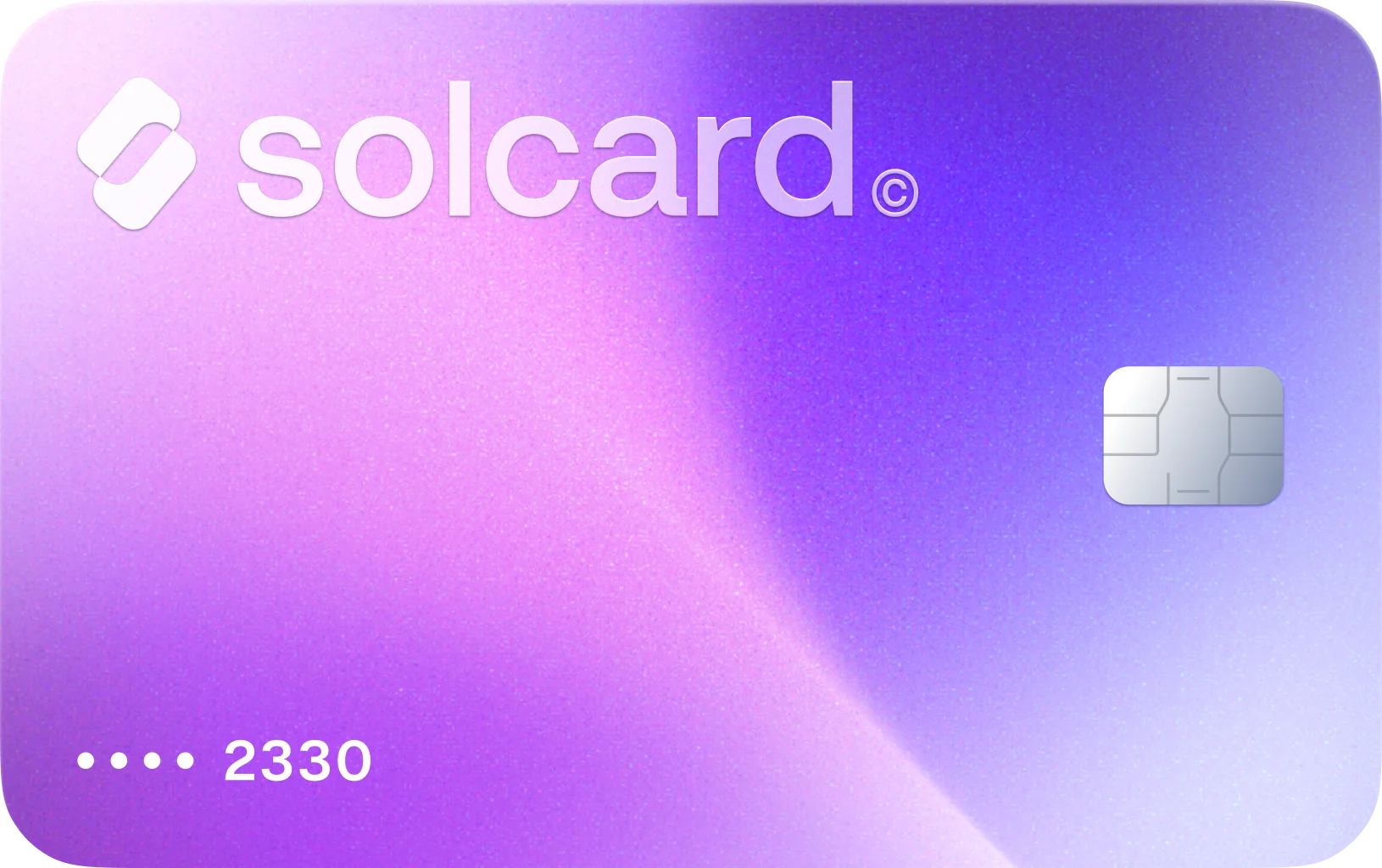
SolCard is a prepaid Visa / Mastercard card. You top up from any wallet with USDT, USDC, SOL and other tokens on Solana, Ethereum, Base, Polygon and more, so you can withdraw from Binance and top up without keeping a balance on an exchange. Brazil, Colombia, Peru, Armenia and New Zealand are not on SolCard's restricted-country list, but check the supported-countries list before you sign up. The US is served for the Virtual card only.
The costs work differently from Binance's 0.9% per-purchase conversion fee:
| Spending $500 from USDT | Binance Card (Global) | SolCard Platinum | SolCard Virtual |
|---|---|---|---|
| Crypto-to-card cost | $4.50 (0.9% conversion) | $0 (0% top-up) | $25 (5% top-up) |
| Per purchase | None listed | $0.30 | $0.30 |
| Card fee | 0 USD issuance; 10 USD physical card shipping | $10 issuance | $10 issuance |
Sources: Binance Global Program fees, SolCard fees, SolCard help-centre fee breakdown for the $0.30 per transaction. FX costs come on top of all three for non-local purchases: 0-1.5% on Platinum and 1-2% on Virtual.
On these numbers, Binance's card costs less than SolCard Virtual, whose 5% top-up is its biggest cost. Against Platinum it depends on how many purchases you make: 15 purchases at $0.30 add up to $4.50, so Platinum comes out lower when the $500 goes on fewer purchases than that, once you've paid its one-time $10 issuance. Platinum requires identity verification and is the only tier with Apple Pay and Google Pay. The Virtual card caps spending at $10,000 a month. SolCard has no cashback, and like other prepaid cards it can fail hotel and car-rental deposit holds. You can see both tiers on the virtual cards page and more matchups on /compare.
If you'd rather keep your crypto off an exchange and off a card balance, a self-custody card spends straight from your own wallet at checkout. Those programmes can stop too, but the money stays in your wallet when they do, as our posts on the Solflare Card pause and the Gnosis Pay card shutdown show. A balance-holding card is different: the 1inch Card shutdown left cardholders a balance to withdraw by a recommended date.
The Binance Card isn't dead, but it now runs in far fewer countries than before 2023. If you live in Brazil or a Global Program country and already keep crypto on Binance, it's a reasonable option. It charges no annual fee and 0.9% to convert crypto at each purchase, and in Brazil it pays spend-based BRL cashback. Order your Payment Priority list so you aren't selling assets you meant to keep.
If you're in Europe, the UK or the US, the card isn't offered, and the 2023 closures came with one to two months' notice. A card that tops up from any wallet, such as SolCard, avoids tying your spending to one exchange's country list, at the cost of a top-up fee on the Virtual tier. Our explainer on what a crypto debit card is covers the basics if you're choosing for the first time.
In some countries. Binance's Brazil card FAQ was updated on October 19, 2026, per Binance. Its Global Program fee page covers Colombia, Peru, Armenia, New Zealand and "some CIS region", per Binance.
Card purchases on the EEA Visa card stopped on December 20, 2023, after the issuer, Contis, stopped issuing it, per Finance Magnates.
Binance's current card pages list no programme for the US or the UK.
The current Brazil card is a Mastercard issued by Pomelo, per Binance, and the Global Program's fee page refers to Mastercard fees. The closed EEA card was a Visa, per Finance Magnates.
Both live programmes charge 0.9% to convert crypto at purchase and no annual fee. The Global Program charges 0.1% when you pay in USDC outside Colombia, Peru, the CIS region and Armenia. FX fees run from 0% to 3% depending on the programme and country, per Binance's Brazil and Global fee pages.
Yes. Brazil requires completed Identity Verification with a valid national ID, and limits on both programmes depend on your verification level, per Binance.
It depends on your region. Check the provider's own country list first. Our best crypto debit cards list compares options, and USDT cards covers cards that spend Tether.