Is There a Solana Mastercard? How the Two Layers Actually Work

There is no blockchain-native Solana Mastercard, because Mastercard is not a blockchain and Solana is not a card network. What does exist, and what nearly everyone searching that phrase actually wants, is a card issued on the Mastercard network that you fund from assets held on Solana. That product is real, it works at any Mastercard terminal, and you can get one today.
The confusion is understandable. Both words describe something money moves across, so it is easy to assume they are competing versions of the same thing. They are not. They sit in a stack, one on top of the other, and once you see where each sits, every headline about Solana and the card networks becomes easy to read correctly.
This guide separates the layers, explains what Mastercard and Visa actually announced in 2026 versus how it was headlined, and answers the practical question underneath the search: can you get a Mastercard you fund with SOL or Solana-based stablecoins? Yes, and here is what that looks like.
| Layer | What it does | Example | Is it a blockchain? |
|---|---|---|---|
| Blockchain | Holds your balance and settles the movement of funds between you and whoever runs the card | Solana, Ethereum, Base | Yes, by definition |
| Card network | Carries the authorization message from the merchant's terminal to the card issuer and back in about a second | Mastercard, Visa | No. A private messaging and settlement network run by a company |
| Issuer / card program | Actually issues the card, holds the fiat balance behind it, and connects the crypto side to the network side | The company whose app you top up | No, but it is the bridge between the two |
| What the merchant sees | A normal card authorization in local currency | "Mastercard, approved, $42.10" | No. The merchant never touches crypto |
Read the table top to bottom and the phrase resolves itself. A "Solana Mastercard" is a Mastercard-network card funded from assets held on Solana. The chain is the funding layer, the network is the acceptance layer, and neither replaces the other.
Mastercard and Visa are usually described as payment systems, which makes them sound like alternatives to a blockchain. They are better understood as private messaging networks with a settlement system bolted on.
When you tap a card, the terminal sends an authorization request to the merchant's acquiring bank, which routes it through the card network to your card's issuer. The issuer checks the funds, approves or declines, and the answer comes back. That round trip is a message, not a transfer of money. The money itself moves later, in batches, between banks.
That is the important distinction. A blockchain settles value and carries the message in the same act. A card network splits the two and keeps its settlement layer private, permissioned and reversible, because reversibility is the whole basis of chargeback rights.
This is also why "which chain is Mastercard on" has no answer. It is not on one. It is a set of rules, member banks, dispute procedures and data centers, and it predates public blockchains by decades. Solana is genuinely fast, but what its throughput actually is has no bearing on whether a supermarket terminal accepts a payment, because that terminal has never heard of Solana and does not need to.
The two layers meet in exactly one place: the company issuing your card can hold your balance on-chain and fund a fiat account behind the card. That is the whole mechanism of a crypto debit card, and it is why the merchant experience is completely ordinary while the funding experience is entirely on-chain.
If you want the merchant to genuinely receive crypto rather than fiat, that is a different product with a different name. Solana Pay does it: a direct on-chain transfer, no card network involved, supported by very few merchants. Near-universal acceptance through a card network versus true on-chain settlement at a handful of merchants is the real choice, and our guide to paying with Solana covers it in depth.
Two real announcements in 2026 put Solana and the card networks in the same sentence, and both were widely misread.
In March 2026, Mastercard launched a global Crypto Partner Program with more than 85 participating companies, including Solana alongside Circle, Ripple, Paxos, Polygon, Binance and others. It is an institutional program aimed at cross-border transfers, business payouts and settlement across Mastercard's network.
What it is not: a consumer card product. Nobody can apply for it, and it does not create a card that is "on" Solana. It is a framework for infrastructure companies to work with Mastercard on how funds move between institutions.
Separately, Visa launched USDC settlement over Solana for US banks, with Cross River Bank and Lead Bank among the first participants. Instead of a five-day settlement window between institutions, those banks settle with Visa in USDC on Solana, around the clock.
This one is genuinely significant and genuinely invisible to cardholders. It changes how Visa and its member banks square up after the fact. It does not change what happens when you tap.
Coverage of these announcements produced headlines along the lines of "Visa and Mastercard Collaborate on Solana Credit Card." That is the conflation this whole page exists to correct, compressed into one line.
What actually happened: both networks are adopting a blockchain, Solana included, as plumbing between financial institutions. Neither has announced a consumer card issued on a blockchain, because that is not something a card network can do. The card layer and the chain layer stayed where they were; the banks behind the card layer started settling with each other over a chain.
So if you read that Mastercard is now "on Solana," the accurate translation is that Mastercard is working with Solana on institutional settlement rails. It is not a card you can hold, and it says nothing about which cards you can personally fund with SOL.
The product that answers the original question already exists, and it is unglamorous in the best way:
- You deposit crypto to a card provider, usually SOL or a stablecoin like USDC or USDT, over Solana or another supported network.
- The provider converts it to fiat and holds that fiat balance behind your card. Some providers convert at deposit, others at the moment of purchase.
- You spend on the Mastercard network at any merchant that takes Mastercard, online or in person. The merchant sees a normal card payment in their local currency.
That is the entire product. There is no on-chain step at checkout, no wallet signature at the till, no confirmation to wait for. The chain did its job before you got to the shop.
Solana is a common funding chain here, and not for ideological reasons: deposits are cheap and confirm in seconds, which matters when the deposit is the only step between you and a working card balance. Our previously published deposit data reflects that: Solana accounts for roughly 70% of deposits across SolCard, and stablecoins for roughly 55%, which lines up with the wider market. Across the industry, crypto card spending passed $1.04 billion in July 2026 and cumulative stablecoin card top-ups reached $13.8 billion, with stablecoins funding around 70% of more than 10 million tracked transactions, USDC at 50.8% of July volume and USDT at 20.3%.
The shape of that data is worth noticing: people are mostly funding cards with dollars that happen to live on a fast chain, then buying groceries. The fuller breakdown is in what crypto people pay with.
For most cardholders in most places, barely. The two networks are accepted at effectively the same merchants, and a merchant that takes cards at all almost always takes both. The differences that do show up are worth knowing.
Acceptance edge cases. Some markets and merchant categories lean one way, and a handful of smaller acquirers support only one network. This bites rarely enough that it should not drive your choice, but if a merchant has declined one network for you before, that is a real reason to hold the other.
Mobile wallets. Whether you can add the card to Apple Pay or Google Pay is set by the card program, not by Mastercard or Visa, so check the tier you are signing up for rather than the network logo. Our Apple Pay walkthrough covers how provisioning works and which cards support it.
Foreign exchange handling. Each network publishes its own rate and the issuer adds a margin on top. The issuer's margin is almost always the bigger number, so compare cards rather than networks.
Where it genuinely matters. A few services single out a network in their own terms, and some older recurring-billing systems are pickier than modern checkouts. If you have a bill in mind that has rejected a card before, match the network to it. Otherwise pick on fees, limits and verification requirements, which is what our comparison of crypto cards ranks on.
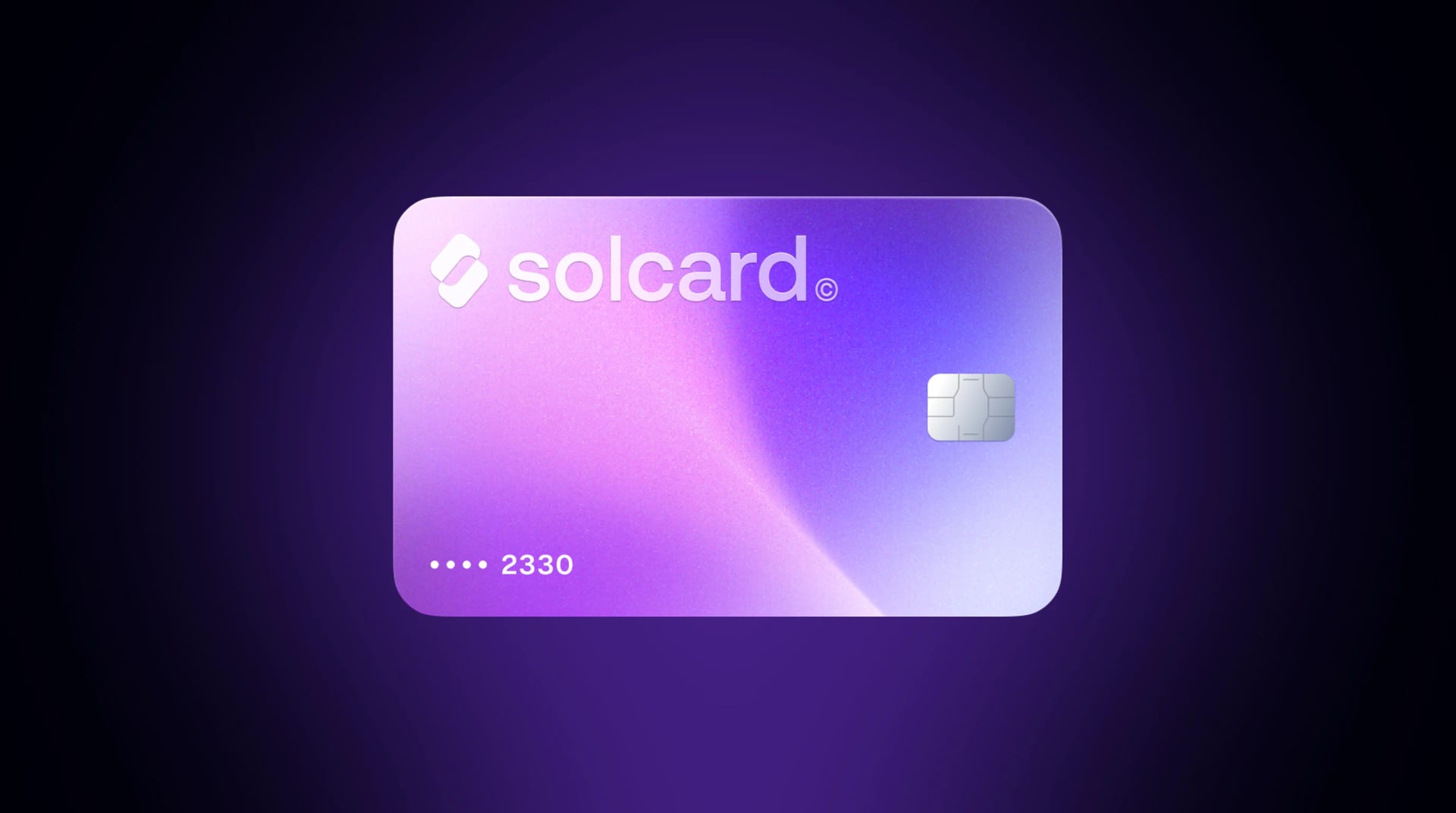
SolCard is the product described above: a crypto-funded card that converts to fiat and spends on the Visa and Mastercard networks. You top it up with SOL, USDC or USDT across 9+ networks, including Solana, Ethereum, Base, BSC, Arbitrum, Polygon and Avalanche. On which network we issue on today, the honest answer differs by tier:
| Virtual | Platinum | |
|---|---|---|
| Card network | Mastercard only | Visa and Mastercard |
| Apple Pay / Google Pay | Not supported | Both supported |
| Identity verification | Not required | Required |
| Issuance fee | $10 one-time | $10 one-time |
| Top-up fee | 5% | 0% |
| Monthly spending limit | $5,000 | No monthly limit |
| Foreign exchange fee | 1–2% | 0–1.5% |
| Annual fee | None | None |
If what you came here for is a Mastercard you can fund from Solana, the Virtual tier is literally that and nothing else: every virtual card we issue today is on the Mastercard network. It opens without identity verification and works online immediately.
For in-store use, take Platinum. It issues on either network, supports Apple Pay and Google Pay, drops the top-up fee to zero and removes the monthly limit, and it requires identity verification. Neither tier charges an annual fee.
Not in the sense of a card issued on the Solana blockchain, because Mastercard is a card network rather than a blockchain. What exists is a Mastercard-network card you fund from assets held on Solana: you deposit SOL or a Solana-based stablecoin, it converts to fiat, and you spend at any Mastercard merchant. That is a real, available product, and for most people it is exactly what they were looking for.
None. Mastercard, Visa, Discover and American Express are all private card networks, none of which runs on a blockchain. Solana is a blockchain, not a card network, and no card network has been built on top of it. What has happened is the reverse direction: Visa now settles some interbank obligations in USDC over Solana, and Mastercard has Solana among the participants in its institutional Crypto Partner Program. Both are back-office settlement arrangements, invisible to anyone holding a card.
Yes. Several card providers accept SOL deposits, convert the balance to fiat, and issue a card on the Mastercard network that spends that balance. SolCard's Virtual tier is issued on Mastercard and accepts SOL, USDC and USDT deposits across Solana and eight or more other networks. The conversion happens on the provider's side, so the merchant only ever sees an ordinary card payment in their own currency.
No, despite headlines suggesting otherwise. Mastercard launched a Crypto Partner Program in March 2026 with more than 85 companies, Solana among them, focused on cross-border transfers and settlement between institutions. Visa separately launched USDC settlement over Solana for US banks. Neither is a consumer card, and neither can be applied for by an individual. Cards you can actually fund with Solana assets come from card programs, not from the networks.
No. The authorization the merchant receives is an ordinary card message in their local currency, identical to one from a bank-issued card. The conversion from crypto to fiat happens on the card provider's side before the transaction ever reaches the network. How you funded the card is between you and your provider, and it is not part of what the terminal sees.
Functionally, almost never. Acceptance is close to identical in most markets and both networks run the same authorization flow in roughly the same time. The real differences come from the card program rather than the network: Apple Pay and Google Pay support, top-up and foreign exchange fees, spending limits, and whether identity verification is required. Compare those, not the logo.
Because the deposit step is the one part of a card's setup where a chain's speed and cost are actually felt by the user. Solana confirms in seconds at low cost, so a top-up becomes a usable balance almost immediately rather than after a wait. Across SolCard, roughly 70% of deposits arrive over Solana and roughly 55% are stablecoins, which matches the wider industry pattern of stablecoins funding about 70% of tracked crypto card transactions in 2026.
It depends entirely on the card program, not on the network or the funding chain. Card programs have to provision cards into Apple Pay and Google Pay explicitly, and many crypto card providers enable it on some tiers and not others. SolCard's Platinum tier supports both Apple Pay and Google Pay; the Virtual tier does not, so it is an online-use card. Check the specific tier before assuming mobile wallet support.
That varies by provider and tier. Some card programs require full identity verification before issuing anything; others offer an entry tier without it, usually with a lower spending limit and a higher top-up fee. SolCard's Virtual tier requires no verification and carries a $5,000 monthly limit and a 5% top-up fee; Platinum requires verification and has no monthly limit and no top-up fee. Requirements change with regulation, so confirm current terms before depositing.