SolCard vs RedotPay: Fees, Limits & Availability (2026)
SolCard vs RedotPay compared in 2026: top-up and conversion fees, FX markups, KYC rules, supported chains, US availability, and physical card costs.

In this article
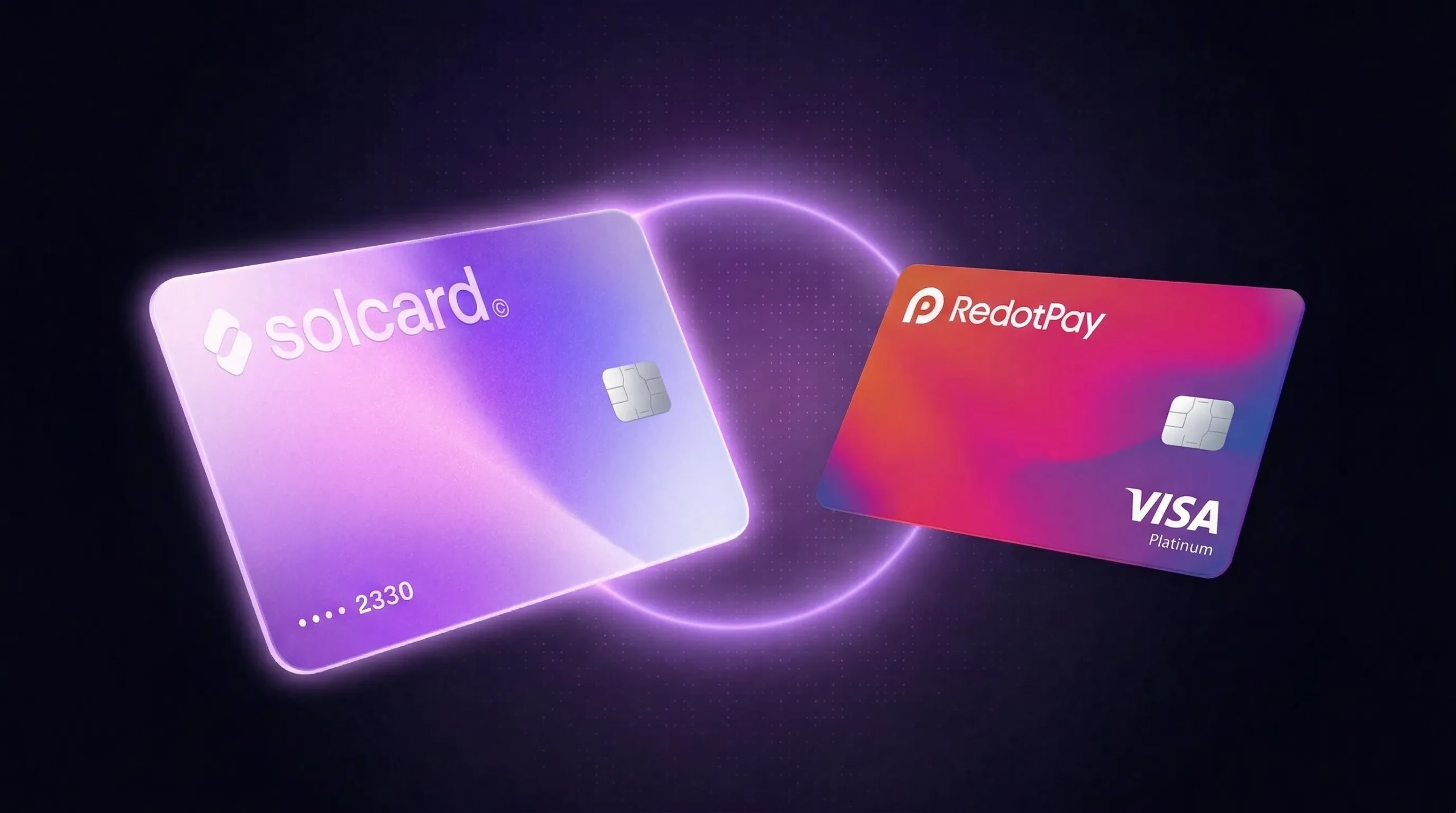
Choose SolCard Platinum if you live outside the US, spend over $30 per purchase, or fund from Solana and multi-chain wallets at 0% top-up; choose RedotPay if you want a dedicated mobile app with Earn rewards and small-ticket purchases where a flat 1% fee beats $0.30 per transaction. Neither card is available in full to US residents: RedotPay blocks US signups completely, while SolCard offers its Virtual tier in the US.
Both cards turn crypto balances into everyday Visa or Mastercard spending with $0 monthly fees. Here is how they actually compare once you line up conversion costs, issuance fees, verification rules, and country coverage.
| Feature | SolCard | RedotPay |
|---|---|---|
| Network | Visa and Mastercard | Visa |
| Card format | Virtual + Platinum (physical & multiple virtual) | Virtual + Physical |
| Identity verification | Not required for Virtual ($10k/mo cap); required for Platinum | Mandatory for all users |
| Top-up / conversion fee | 0% (Platinum) / 5% (Virtual) | 0% crypto deposit; 1% conversion on spend (3% card top-up) |
| Per-transaction fee | $0.30 (SolCard fee breakdown) | None beyond 1% conversion |
| FX markup | 0-1.5% (Platinum); 1-2% (Virtual) | 1.2% |
| Monthly fee | $0 | $0 |
| Card issuance | $10 per card | $10 virtual / $100 physical |
| Supported crypto | SOL, USDC, USDT, BTC, ETH, LTC + tokens across 9+ networks | BTC, ETH, USDT, USDC |
| Supported networks | Solana, Ethereum, Base, Polygon, and more (9+ chains) | Ethereum, Tron, BSC, Polygon, Bitcoin |
| Cashback | None | None (Earn feature on idle balances) |
| Availability | Most countries (US: Virtual only) | 100+ countries (no US, Australia, Japan, Singapore) |
| Apple Pay / Google Pay | Yes (Platinum only) | Yes |
SolCard is a prepaid Visa and Mastercard card funded directly from your crypto wallet, with no bank account and no credit check. You deposit SOL, USDC, USDT, native BTC and LTC, or native ETH and other tokens across 9+ networks including Solana, Ethereum, Base, and Polygon.
SolCard runs two tiers (full schedule on our fees page and fee breakdown):
- Virtual: no ID required, $10,000 monthly limit, 5% top-up fee, $0.30 per transaction, 1-2% FX spread, $10 one-time issuance per card, online spending only. Available in the US and most countries worldwide.
- Platinum: identity verification required, 0% top-up fee, $0.30 per transaction, 0-1.5% FX spread, no monthly limit, $10 issuance per card, multiple virtual cards plus physical card access, and Apple Pay and Google Pay. Not available in the US.
RedotPay is a Hong Kong-based Visa card platform operating across 100+ countries. Every account requires full KYC (ID and liveness check via Sumsub) before issuing a card.
You deposit BTC, ETH, USDT, or USDC onto your RedotPay wallet, and RedotPay converts crypto to fiat at checkout. It supports Apple Pay, Google Pay, a physical Visa card ($100 issuance) for ATM withdrawals, and an Earn product for idle balances. RedotPay does not support Solana deposits.
The break-even point between SolCard Platinum and RedotPay is $30 per transaction, because SolCard Platinum charges a flat $0.30 per purchase while RedotPay charges a 1% conversion fee on every crypto-funded charge.
| Scenario (USD spend) | SolCard Platinum | RedotPay | SolCard Virtual |
|---|---|---|---|
| Single $100 purchase | $0.30 | $1.00 | $5.30 ($5 top-up + $0.30) |
| Single $500 flight or hotel | $0.30 | $5.00 | $25.30 |
| 30 small purchases of $20 ($600 total) | $9.00 | $6.00 | $39.00 |
| Physical card issuance | $10 | $100 | N/A (virtual only) |
Watch the $30 break-even point
On purchases above $30 (groceries, flights, software bills, dining), SolCard Platinum's flat $0.30 fee is cheaper than RedotPay's 1%. On lots of $5 coffees and $10 rides, RedotPay's 1% comes out ahead.
On cross-currency purchases, RedotPay adds a 1.2% FX markup on top of its 1% conversion fee (2.2% combined), while SolCard Platinum charges 0-1.5% FX with 0% top-up. ATM withdrawals on RedotPay carry a 2% fee (3% above $10,000/month).
RedotPay requires full KYC for every user and blocks registration in the US, Australia, Japan, Singapore, Cambodia, mainland China, Russia, and other restricted jurisdictions.
SolCard serves most countries worldwide (excluding restricted jurisdictions such as Cuba, North Korea, Egypt, Iran, Myanmar, Nigeria, Russia, South Africa, Syria, Ukraine, Venezuela, Belarus, and Hong Kong). In the US, only the Virtual tier is available; Platinum requires verification and is offered outside the US only.
Neither card offers full features in the United States
RedotPay does not accept US residents at all. SolCard allows US residents to use its online-only Virtual tier ($10k/month cap, 5% top-up), but not Platinum or Apple Pay. If you live in the US and want 0% fees on USDC with Apple Pay, compare against Coinbase Card.
Both cards accept BTC, ETH, USDC, and USDT. The big difference is Solana and L2 coverage: SolCard supports SOL and multi-chain deposits across 9+ networks (Solana, Ethereum, Base, Polygon, and more), whereas RedotPay skips Solana and focuses on Ethereum, Tron, BSC, Polygon, and Bitcoin.
Pick SolCard if you hold SOL or multi-chain stablecoins across Solana and Base, if most of your charges are above $30 (where Platinum's $0.30 flat fee beats 1%), if you want a $10 physical card instead of $100, or if you need an online Virtual card without ID verification.
Pick RedotPay if you live in a supported non-US country, mostly make small under-$30 purchases, do not need Solana deposits, and want a mobile app with an integrated Earn balance.
For more comparisons, see our best crypto debit cards guide, SolCard vs MetaMask Card, SolCard vs Gemini Card, and our review of whether SolCard is legit.
On purchases over $30, SolCard Platinum ($0.30 flat, 0% top-up) is cheaper than RedotPay (1% conversion fee). On frequent small purchases under $30, RedotPay's 1% beats $0.30. SolCard Virtual (5% top-up) is the priciest option and only makes sense when you want online spending without ID verification.
Yes. Identity verification is mandatory for every RedotPay user before you can activate a card.
No. RedotPay supports BTC, ETH, USDT, and USDC on Ethereum, Tron, BSC, Polygon, and Bitcoin, but does not support Solana deposits.
RedotPay charges $100 to issue a physical Visa card ($10 for virtual). SolCard charges $10 per card across Virtual and Platinum (physical access is on Platinum outside the US).
RedotPay is not available in the US. SolCard offers its online-only Virtual tier in the US ($10,000/month limit, 5% top-up), while Platinum is available outside the US only.
Neither card offers traditional purchase cashback. RedotPay offers an Earn product on idle wallet balances, and SolCard competes on 0% Platinum top-ups and multi-chain support.
If you are outside the US and verify for Platinum, SolCard wins on medium-to-large purchases ($30+), physical card cost ($10 vs $100), and Solana/multi-chain deposits. RedotPay earns its spot for small-ticket everyday spending where 1% beats $0.30 and you already live inside its supported countries and EVM/Tron rails.