Can You Actually Spend Bitcoin Like Cash in 2026?
Can you spend Bitcoin like cash in 2026? Direct merchants, Square's Lightning rollout, crypto debit cards, IRS Form 1099-DA taxes, and where friction remains.

In this article
You can spend Bitcoin almost anywhere in 2026, though rarely like physical cash: direct Lightning Network checkout now reaches millions of Square merchants, while everywhere else relies on a crypto debit card or gift card converting BTC to fiat behind the scenes.
The biggest catch is not acceptance anymore. It is taxes and volatility: in the US and most major economies, every coffee bought with appreciated Bitcoin is a taxable disposal. Here is what works today, what it costs, and how most Bitcoin holders handle everyday spending.
- Direct merchant acceptance and Lightning Network: Pay straight from a Bitcoin or Lightning wallet at participating businesses (now boosted by Square's Lightning rollout).
- Crypto debit cards: Load BTC or stablecoins onto a Visa or Mastercard that converts to fiat and works at 150M+ merchants worldwide.
- Gift cards: Buy digital vouchers for Amazon, Walmart, or Uber via Bitrefill, Coinsbee, or Fold using on-chain BTC or Lightning.
Direct Bitcoin acceptance covers a growing slice of online and retail commerce, led by companies using processors like BitPay (Newegg, Microsoft, AT&T, Beyond, and select luxury boutiques) alongside PayPal's crypto checkout and Flexa's Spedn app at chains such as Home Depot.
The biggest leap for in-person Bitcoin came from the Lightning Network, a layer-2 payment rail that settles Bitcoin in seconds for fractions of a cent:
- Monthly Lightning volume crossed $1.1 billion in early 2026, with network capacity passing 5,700 BTC in late 2025.
- Square rolled out Lightning Bitcoin acceptance across its US point-of-sale hardware (4M+ merchants), waiving processing fees through 2026 before introducing a 1% fee in 2027.
- Cash App supports zero-fee Lightning sends and lets you pay Lightning invoices straight from a USD balance, plus includes a built-in Bitcoin Map to find nearby accepting shops.
Even with Square's rollout, most local supermarkets, gas stations, and online subscriptions still do not display a Lightning QR code. That is where cards and gift cards bridge the rest.
Amazon does not accept Bitcoin directly. To spend BTC there, either buy an Amazon gift card via Bitrefill or Fold over Lightning (typically 0% to 3% markup, delivered in minutes) or attach a Visa/Mastercard crypto debit card to your Amazon account. See our buying on Amazon with crypto guide for a full fee comparison.
A crypto debit card turns Bitcoin or stablecoins into a normal Visa or Mastercard payment at 150M+ merchants worldwide.
| Card | Network | Top-up / conversion fee | Rewards | US available |
|---|---|---|---|---|
| SolCard | Visa and Mastercard | 0% (Platinum) / 5% (Virtual); $0.30/tx | None | Virtual only |
| Coinbase Card | Visa | 0% USD/USDC; conversion spread on BTC | Variable rotating crypto | Yes (excl. Hawaii) |
| Crypto.com Card | Visa | 1% debit top-up (US) / 0% fiat | 0% to 4.5% (tier-based) | Yes |
For eight cards compared side by side, see our 2026 best crypto debit cards guide.
In the United States, the IRS treats Bitcoin as property, not currency. Buying a $6 latte with Bitcoin you bought at half its current price triggers a capital gain, and brokers must report cost basis on Form 1099-DA starting with the 2026 tax year.
Hold Bitcoin, spend stablecoins
Many Bitcoin holders keep BTC untouched as a long-term asset and load USDC or USDT onto a crypto card for groceries, travel, and bills. Because stablecoins stay pegged to $1.00, daily spending avoids both 5% to 10% price swings and capital-gains paperwork. Read our crypto spending and taxes guide.
- Irreversibility: On-chain and Lightning payments cannot be reversed if you mistype an invoice or get scammed; card rails still carry dispute mechanisms.
- Volatility: A 5% daily move makes pricing everyday budgets in BTC awkward.
- Tax reporting: Paper cash does not create a capital-gains schedule every time you buy lunch.
- Uneven local coverage: Outside Lightning-enabled Square terminals, most physical terminals still expect Visa, Mastercard, or Apple Pay.
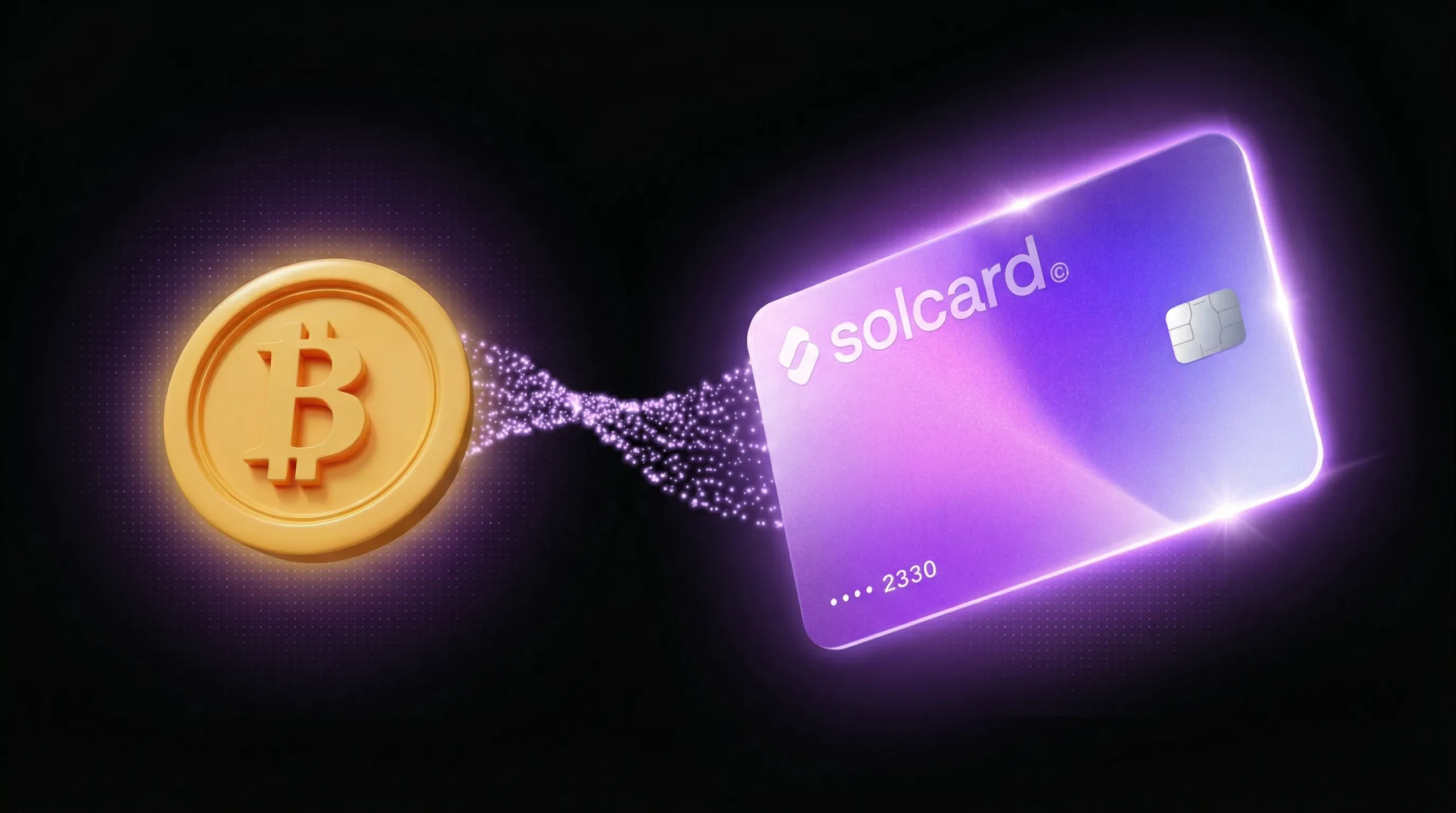
SolCard is a multi-chain prepaid Visa and Mastercard card funded directly from your crypto wallet, with no bank account and no credit check. You can deposit native BTC and LTC, wBTC on Solana, or SOL, USDC, and USDT across 9+ networks including Solana, Ethereum, Base, and Polygon.
- Virtual: $10 one-time issuance, 5% top-up fee, $0.30 per transaction, 1-2% FX spread, $10,000/month limit, online-only, no ID required (available in the US and most countries).
- Platinum: $10 one-time issuance, 0% top-up fee, $0.30 per transaction, 0-1.5% FX spread, no monthly limit, physical and virtual cards, Apple Pay and Google Pay (KYC required, outside the US).
See the SolCard fee breakdown and our how to pay with crypto guide for all five spending routes.
Not directly at the register. You can pay with a Bitcoin-funded crypto debit card (such as SolCard Platinum outside the US or Coinbase Card in the US) or buy a Walmart gift card on Bitrefill via Lightning.
Not directly. Use a crypto debit card on Amazon checkout or buy an Amazon gift card with Bitcoin Lightning through Bitrefill or Fold.
Direct Lightning Network payments cost fractions of a cent where merchants accept them. Everywhere else, a 0% top-up crypto card (like SolCard Platinum) or low-markup Lightning gift card beats Bitcoin ATMs, which routinely charge 10% to 25%.
In the US and most major economies, yes. Every BTC purchase is treated as a property disposal, with Form 1099-DA broker reporting active for the 2026 tax year.
El Salvador rescinded Bitcoin's mandatory legal tender status in 2025 under its IMF agreement, so merchants are no longer required to accept BTC, though the country still holds over 6,000 BTC in reserves.
Lightning and Square brought direct Bitcoin checkout closer to everyday reality than it has ever been, yet tax rules and daily price swings still make Bitcoin awkward as pocket cash. Use Lightning where a merchant takes it directly, and keep a stablecoin-funded prepaid card for every other Visa or Mastercard terminal.