Best Crypto Card Providers in 2026: Prepaid Cards, Wallets & Payment Options
The best crypto card providers in 2026 fall into four groups: exchange-linked providers, standalone prepaid card issuers, self-custodial wallet providers, and payment gateways. Which one suits you depends less on any headline cashback rate and more on where your crypto already sits, whether you will complete identity verification, and how often you top up.
This guide is about picking a provider, not ranking individual cards. If you want the card-by-card breakdown with fees and cashback tiers, read our comparison of the best crypto debit cards. What follows is the layer above that: how the providers differ structurally, and which type fits which user.
Three separate companies usually sit behind any crypto card, and confusing them is the most common mistake buyers make.
The provider is the brand you sign up with. It holds your crypto, runs the app, and converts your tokens to fiat. This is who you are really trusting.
The issuer is the licensed bank or e-money institution that legally issues the card. Most crypto brands do not hold a card licence and partner with one that does.
The network is Visa or Mastercard. It moves the money and sets acceptance. It has nothing to do with crypto.
This matters because your risk sits almost entirely with the provider. Network protections cover fraudulent transactions. They do not cover a provider that freezes your account, halts withdrawals, or fails. Choose the provider carefully; the network is largely interchangeable.
Cards issued by the exchange where you already trade, such as Coinbase, Crypto.com, or Binance. Your trading balance funds the card, so there is no separate deposit step.
Best for: people who already keep meaningful balances on one exchange. Trade-off: you are deepening your exposure to a single custodian, and the richest reward tiers usually require staking the exchange's own token for a fixed term. That is an investment decision disguised as a rewards programme.
Providers whose product is the card itself, funded by a crypto deposit. SolCard and RedotPay sit here.
Best for: people who self-custody, hold crypto across several chains, or want a card without opening an exchange account. Trade-off: you deposit and convert explicitly, so the top-up fee is visible rather than buried in a spread. Visible is better, but you have to actually do the maths.
The MetaMask Card is the notable example. Funds stay in your own wallet until a purchase settles.
Best for: users who will not hand custody to anyone. Trade-off: narrower country coverage and a more technical setup.
Not cards at all. Providers like BitPay's checkout product or Stripe's crypto rails let a merchant accept crypto directly. Relevant only if you are selling, not spending. Our guide to crypto payment gateways covers that side.
Six questions separate the good providers from the rest.
1. Where do the fees live? Every provider charges somewhere: a percentage top-up fee, a conversion spread inside the exchange rate, an FX markup, or a monthly subscription. A provider advertising "zero fees" has moved the cost into the spread. Compare the fiat amount that lands on your card against the market rate at that moment. That number is the only honest one.
2. Is verification optional? Most providers now require KYC for any real functionality. A shrinking number still issue a usable card without it, always with a higher fee and a lower cap.
3. Which chains can you deposit from? Depositing from the wrong network is the most common way people lose funds. Broad multi-chain support removes a bridging step and a real risk.
4. Does it serve your country? Coverage varies widely between providers and changes without much notice. Confirm on the provider's own site before depositing anything. SolCard is not currently available in the United States.
5. Are the rewards realistically reachable? A headline rate available only to users staking six figures is marketing, not a benefit. Ask what someone with your balance actually earns.
6. How fast is a card replaced? Virtual cards should be freezable and reissuable in the app in seconds.
| Provider type | Funding source | Verification | Fee model | Custody |
|---|---|---|---|---|
| Exchange-linked | Exchange balance | Always required | Conversion spread; tiers often need token staking | Exchange holds funds |
| Standalone prepaid | Crypto deposit | Sometimes optional | Explicit top-up fee plus FX | Provider holds funds |
| Self-custodial | Your own wallet | Required | Network and swap costs | You hold funds |
| Payment gateway | Merchant-side | Business KYC | Merchant processing fee | Varies |
Fee rates are deliberately absent from this table. They change frequently and differ by region and tier, so check each provider's own published terms rather than trusting a figure copied around the web.
Prepaid is the dominant model in crypto, so it is worth knowing what a good one looks like.
Instant issuance. A virtual number in seconds, not days. SolCard issues its Virtual card in roughly 18 seconds.
No monthly fee. Recurring charges quietly outweigh the top-up fee for light spenders.
A clean FX policy. You will pay FX somewhere on foreign purchases. A provider that states the markup plainly beats one that does not.
Mobile wallet support. Without it, a virtual card cannot be tapped in a store.
A published blocked-category list. Providers block certain merchant categories. Knowing which ones before you depend on the card avoids a declined payment.
The best digital wallets do not replace a card, they complete it. Apple Pay and Google Pay store the card credential and let you tap in physical stores. Self-custodial wallets like Phantom or MetaMask hold the crypto you fund the card with.
Neither type lets you pay a merchant that does not accept crypto. That is the card's job. In practice the sensible setup is: hold long-term assets in a self-custodial wallet, move spending money to a card provider, and add the card to a mobile wallet for in-store use. Our guide on using Apple Pay with a crypto card walks through the setup.
Among the top digital currencies people actually spend, stablecoins dominate for one reason: their value does not move while a deposit confirms, so the balance that arrives is the balance you expected.
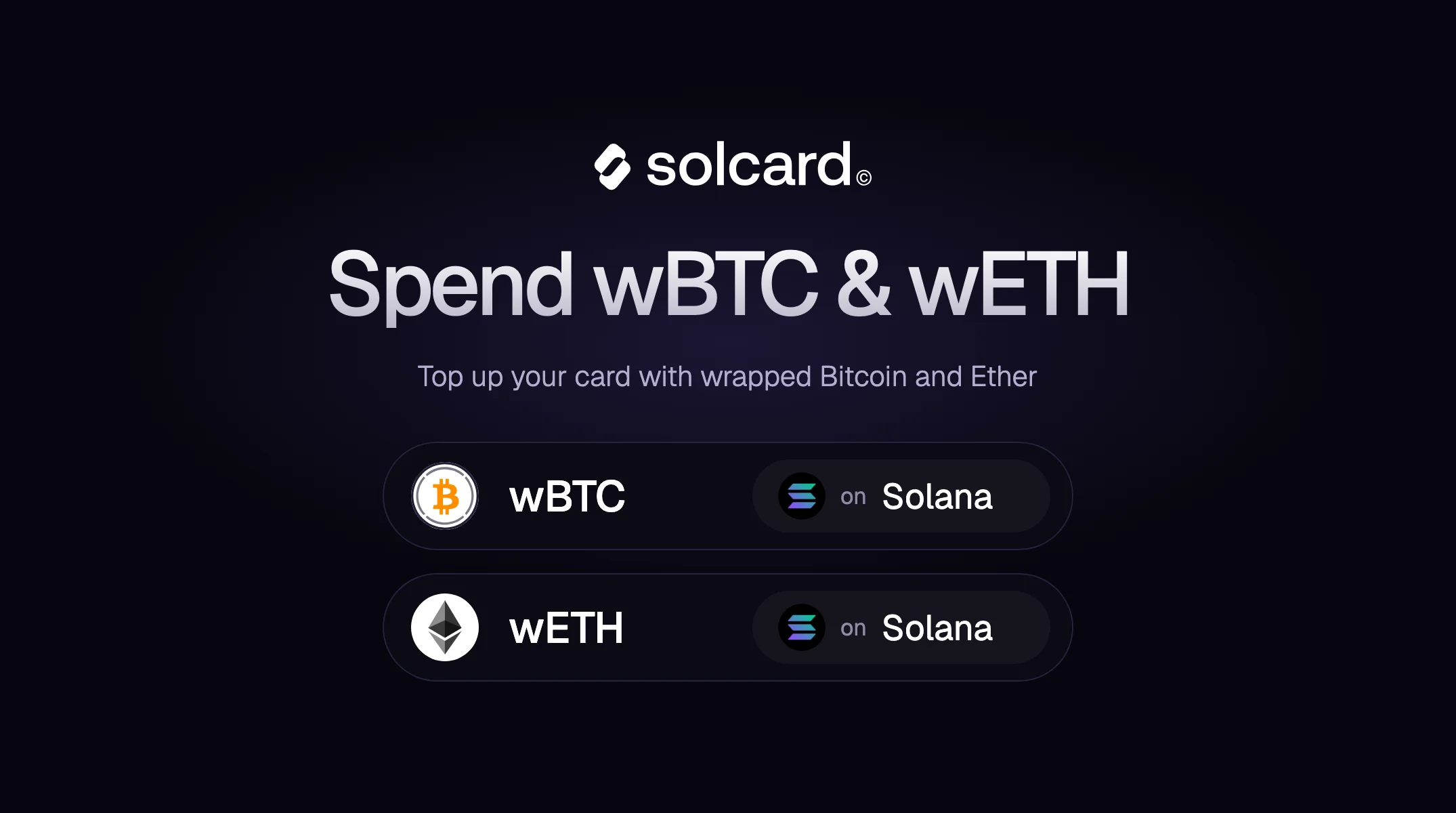
USDC and USDT are supported almost universally. SOL, ETH, and BTC are widely supported but expose you to price movement between sending and settling, and converting them is a taxable disposal in most jurisdictions. SolCard supports SOL, USDC, USDT, SOLC, and JITO across 9+ networks including Solana, Ethereum, Base, and Polygon, and also takes USDT on Tron, USDG, and EURC, wrapped BTC and ETH on Solana, and native ETH, BNB, POL, AVAX and HYPE.
Whatever you send, confirm the network as well as the token. Sending USDC on a chain your provider does not support is the single most common recovery ticket in this industry.
A card is the most flexible route, not the only one.
Direct crypto payment works where a merchant accepts it, which is a small share of merchants.
Crypto-bought gift cards work well for a specific retailer but usually carry a premium over face value and cannot be used elsewhere.
Peer-to-peer transfers move value between people and do nothing for merchant checkout.
For most people, a card covers the widest range of real purchases. How to pay with crypto compares the routes in detail.
SolCard is a standalone prepaid provider built on Solana, with two tiers that reflect the central trade-off in this market:
- Virtual: no identity verification, issued in seconds, 5% top-up fee, 1–2% FX, $5,000 monthly limit, no mobile wallet support.
- Platinum: KYC verified, 0% top-up fee, 0–1.5% FX, no monthly limit, Apple Pay and Google Pay support.
Both tiers carry a one-off $10 issuance fee and no monthly fee. The card is accepted wherever Visa or Mastercard is, across 200+ countries.
The choice is straightforward. If you spend regularly, Platinum's zero top-up fee recovers the verification effort quickly. If you top up occasionally or will not verify, Virtual's 5% is the price of skipping that step.
The largest by user base are the exchange-linked providers, chiefly Coinbase, Crypto.com, and Binance, since they can convert existing customers. Standalone providers such as SolCard and RedotPay compete on faster onboarding and lighter verification. MetaMask leads the self-custodial category. Size is not the same as suitability, and the biggest provider is rarely the cheapest for a given spending pattern.
It depends entirely on how you spend. A zero top-up provider wins for frequent spenders; a provider charging per top-up but nothing monthly wins for occasional ones. Compare on your own annual volume rather than on a headline rate, and verify current fees on each provider's own terms page before deciding.
No. Standalone prepaid providers accept a deposit from any wallet, so you can go from a self-custodial wallet straight to a spendable card without opening an exchange account.
The card network side carries standard fraud protection. The custody side is the real exposure: most providers hold your funds until you spend them, so a freeze, hack, or failure puts that balance at risk. Keep only spending money on a card and hold the rest yourself. Our look at whether SolCard is legit covers what to check before trusting any provider.
The provider is the brand and app you interact with and the party holding your crypto. The issuer is the licensed bank that legally issues the card on the provider's behalf. Most crypto brands do not hold a card licence themselves, which is why the name printed on a card's terms is often a bank you have never heard of.